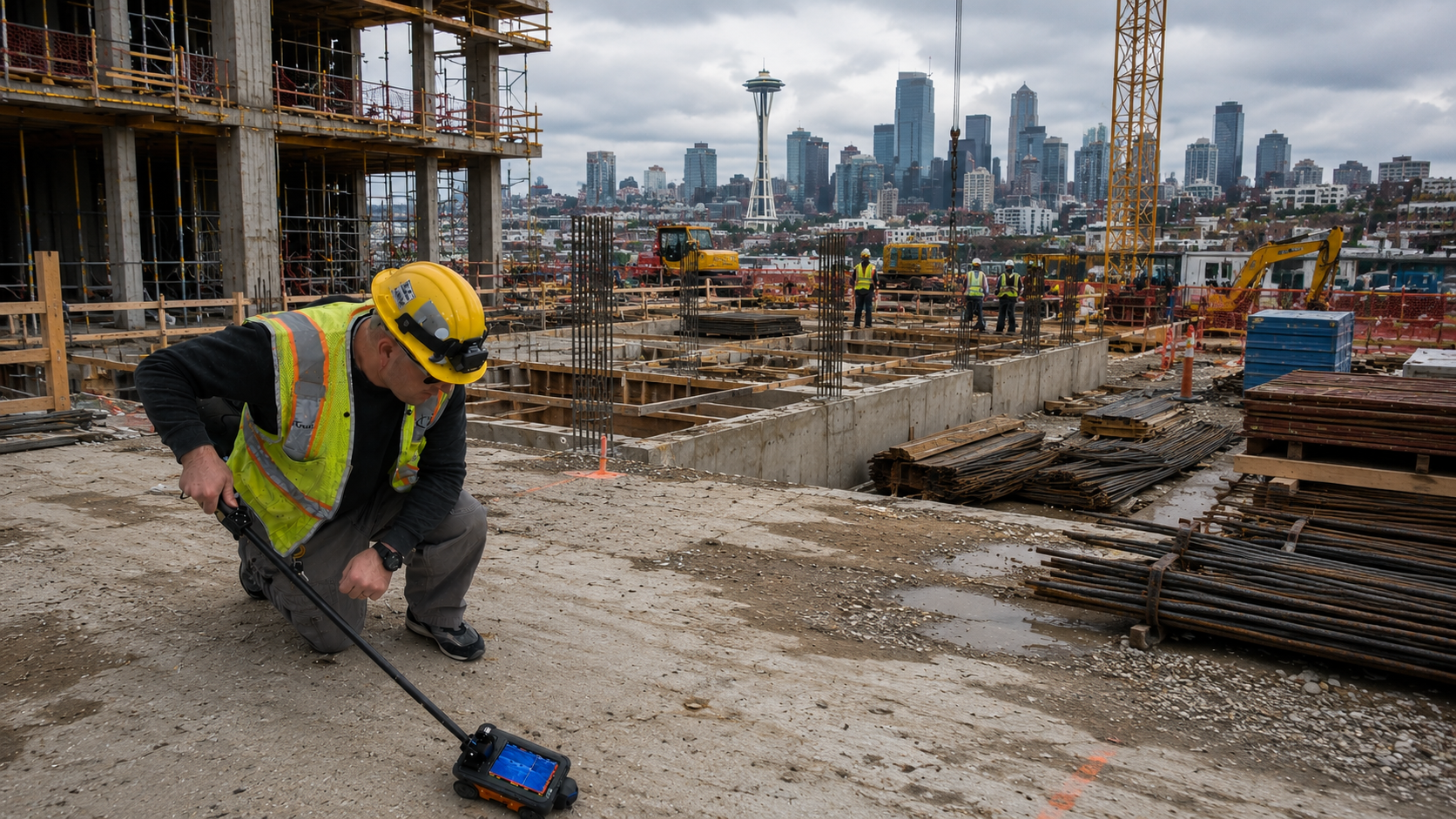
When people hear the term “X-ray concrete scanning,” they often assume it is the standard method for locating embedded objects within concrete structures. In reality, X-ray technology is rarely used on active construction sites today. Modern projects typically rely on more practical and efficient inspection methods that can provide valuable subsurface information without many of the operational constraints associated with radiographic testing.
GPR concrete scanning is one of the most commonly used methods for utility locating and structural imaging professionals to survey concrete before drilling, coring, cutting, or anchor installation. Grasping the reasons behind the industry’s move away from older X-ray techniques could help project professionals make better decisions about how to investigate concrete structures.
Understanding Traditional X-Ray Concrete Inspection
Radiographic concrete inspection uses radiation to create images of internal features within a concrete element. Historically, this method was used to identify reinforcing steel, conduits, voids, and other embedded components.
While radiographic inspection can provide useful information in certain controlled environments, it presents several operational challenges. Specialized safety procedures are required when working with radiation-producing equipment. Access restrictions may be necessary during testing, and project schedules can be affected by safety protocols and site coordination requirements.
Because of these factors, radiographic inspection is generally less practical for many active construction and facility projects.
Why Ground Penetrating Radar Became the Preferred Alternative
The industry has increasingly adopted GPR concrete scanning because it offers a non-destructive method for evaluating concrete structures while minimizing disruption to surrounding activities.
Ground Penetrating Radar transmits electromagnetic signals into the concrete and records reflections from subsurface features. These reflections can help identify reinforcing steel, post-tension cables, conduits, voids, and other anomalies that may require consideration before construction work begins.
Modern scanning equipment allows technicians to collect data efficiently and review findings while remaining responsive to changing site conditions. This flexibility has made Ground Penetrating Radar a common choice for structural investigations across commercial, industrial, and infrastructure projects.
Practical Advantages for Construction Projects
Many project teams select Ground Penetrating Radar because of the operational advantages it provides compared to radiographic methods.
Some common benefits include:
- Non-destructive subsurface imaging
- Reduced disruption to ongoing site activities
- Faster deployment on active projects
- Ability to scan a variety of concrete elements
- Support for drilling, coring, cutting, and anchoring planning
- Integration with other locating and inspection methods when necessary
These advantages have contributed to the widespread use of concrete slab scanning during renovation, maintenance, and construction projects.
Understanding Service Limitations
Like any detection technology, Ground Penetrating Radar has operational limitations that should be considered when interpreting results.
Detection capabilities can be influenced by factors such as concrete composition, reinforcement density, moisture conditions, structural complexity, and site accessibility. Interpretation of scan data requires trained analysis, and findings should always be evaluated within the context of project objectives and site conditions.
For this reason, locating professionals may combine multiple technologies when additional information is required. Electromagnetic locating, utility mapping, or other inspection methods may supplement scanning activities depending on the project scope.
These considerations apply whether performing concrete slab scanning on a small renovation project or evaluating larger structural components.
The Modern Approach to Structural Imaging
Today, construction professionals increasingly rely on advanced scanning technologies rather than radiographic methods when investigating concrete structures. The ability to collect subsurface information efficiently while maintaining site productivity has made Ground Penetrating Radar a valuable tool for many applications.
As a result, concrete scanning frequently involves modern structural imaging equipment designed to support informed planning before drilling, cutting, or coring activities occur. While radiographic inspection still exists in specialized circumstances, it is no longer the primary method used for most concrete investigations.
Conclusion
The decline of traditional X-ray concrete inspection reflects the industry’s movement toward more flexible and practical non-destructive evaluation methods. Modern Ground Penetrating Radar technology provides valuable subsurface information while helping project teams manage safety, scheduling, and operational considerations. For organizations seeking professional concrete scanning in Washington, C-N-I Locates Ltd. provides structural imaging and utility detection services that support informed decision-making before work begins.