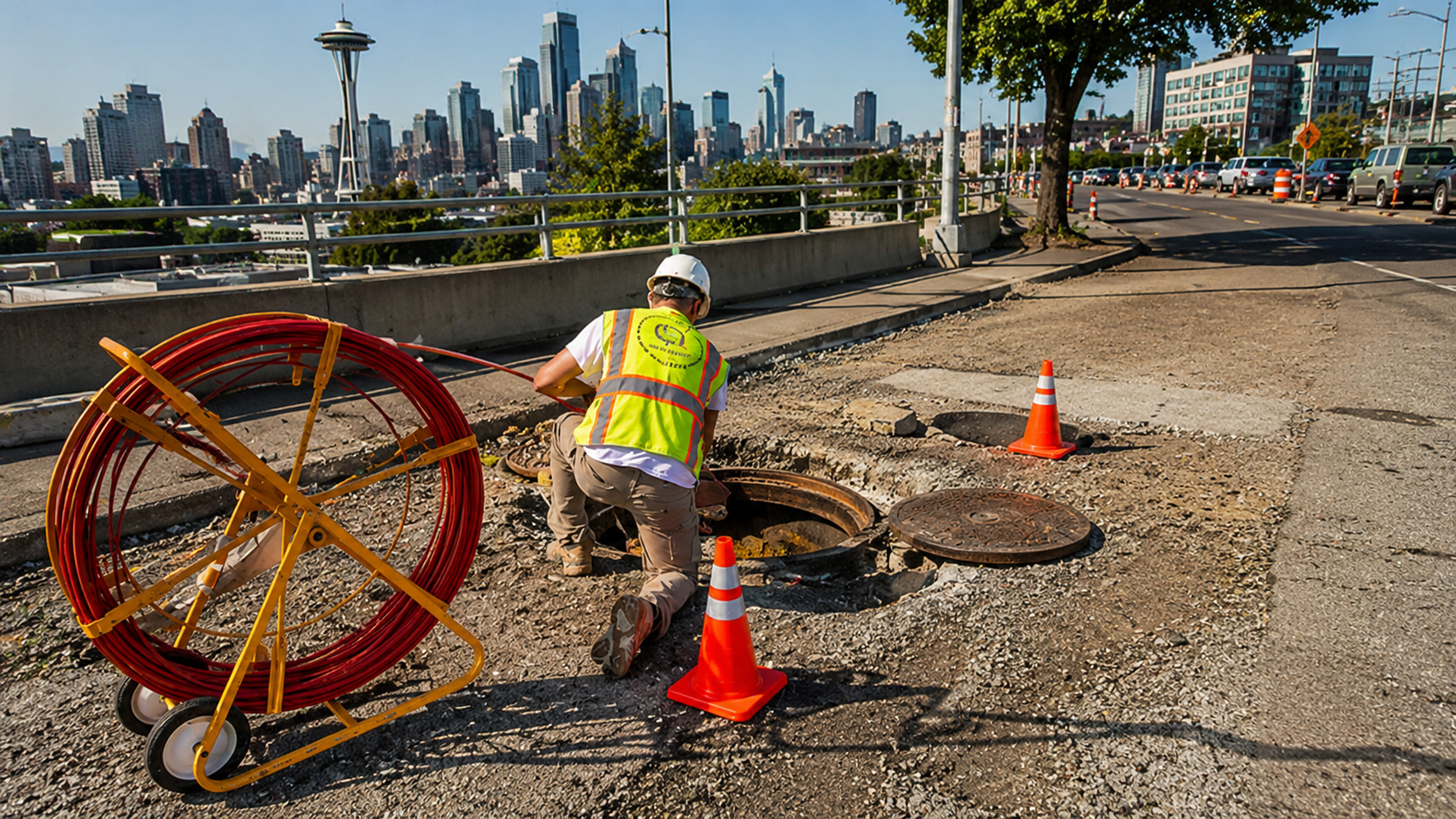
Plastic utility lines are widely used for water, irrigation, sewer, reclaimed water, and other underground infrastructure because they are durable and resistant to corrosion. However, unlike metallic pipes and cables, plastic utilities do not naturally conduct electromagnetic signals. This creates a significant challenge during underground utility locating activities because traditional conductive locating equipment relies on a signal travelling along a metallic path.
Tracer wires help address this challenge by providing a conductive path that can be detected using electromagnetic locating equipment. When properly installed and maintained, tracer wires support safer utility identification and improve the efficiency of future locating operations.
Understanding the Challenge of Nonconductive Utilities
Electromagnetic utility locating equipment is commonly used to identify metallic utilities below the ground surface. A transmitter applies a signal to a conductive utility, and a receiver follows that signal along the utility’s path.
Plastic pipes do not conduct these signals. Without an installed tracer wire, locating professionals may have limited options for identifying the route of a nonconductive utility. As a result, additional detection methods may be required depending on site conditions, utility type, and available access points.
This is one reason why tracer wires are considered an important component of many plastic utility installations.
How Tracer Wires Support Utility Detection
A tracer wire is typically installed alongside a plastic pipe during construction. The wire creates a conductive path that allows electromagnetic locating equipment to trace the utility’s route after installation.
When access to the tracer wire is available, locating professionals can connect a transmitter and follow the signal using a receiver. This process can help identify the horizontal alignment of the utility and support project planning before excavation or construction activities begin.
In many situations, a functioning tracer wire can reduce the need for more extensive investigative methods while improving efficiency during field operations.
What Happens When a Tracer Wire Is Missing or Damaged?
Tracer wires can become disconnected, broken, improperly grounded, or inaccessible over time. When this occurs, locating a plastic utility may become more complex.
Field personnel may need to evaluate alternative detection methods, including:
- Ground Penetrating Radar (GPR) for subsurface imaging.
- Acoustic detection techniques when conditions permit.
- Video camera inspections with sondes for certain pipe systems.
- Review of available utility records and site documentation.
- Utility mapping data collected during previous projects.
The appropriate approach depends on site conditions, utility depth, soil characteristics, accessibility, and other operational factors.
Because no single technology is effective in every environment, utility locating projects often involve multiple complementary methods.
The Role of Ground Penetrating Radar
When tracer wires are unavailable or cannot be used effectively, ground penetrating radar utility locating may provide additional subsurface information. GPR technology transmits radar signals into the ground and records reflections from buried objects and subsurface features.
Ground Penetrating Radar (GPR) can assist in identifying nonconductive utilities, unknown underground features, voids, and other anomalies. However, performance is influenced by soil composition, moisture content, utility characteristics, and site conditions.
For this reason, ground penetrating radar utility locating is frequently used alongside electromagnetic locating rather than as a direct replacement for it.
Why Proper Installation Matters
The long-term effectiveness of a tracer wire depends heavily on installation quality. Poor splices, inadequate connections, damaged insulation, or missing access points can limit future locating capabilities.
Property owners, contractors, and utility operators often benefit when tracer wires are installed according to project requirements and remain accessible for future maintenance and locating activities.
When a utility can be traced efficiently, project planning and utility verification efforts are generally more straightforward.
Supporting Private Utility Investigations
Many private utility systems contain plastic infrastructure that may not be included within public utility marking programs. In these situations, a private utility locating service in Washington may evaluate available records, site conditions, utility access points, and applicable detection technologies to identify underground infrastructure.
Tracer wires often play a valuable role in these investigations because they provide a detectable pathway for electromagnetic locating equipment. When tracer wires are unavailable, additional technologies may be necessary to support underground utility locating efforts and gather information about subsurface conditions.
Conclusion
Tracer wires are a critical component of many plastic utility installations because they help make nonconductive infrastructure detectable through electromagnetic locating methods. While additional technologies such as Ground Penetrating Radar (GPR), acoustic detection, video inspections, and utility mapping may support investigations, a properly installed tracer wire often simplifies future locating activities. For organizations and property owners seeking professional utility detection, mapping, and inspection services, C-N-I Locates Ltd. provides specialized solutions that support informed decisions around underground infrastructure.