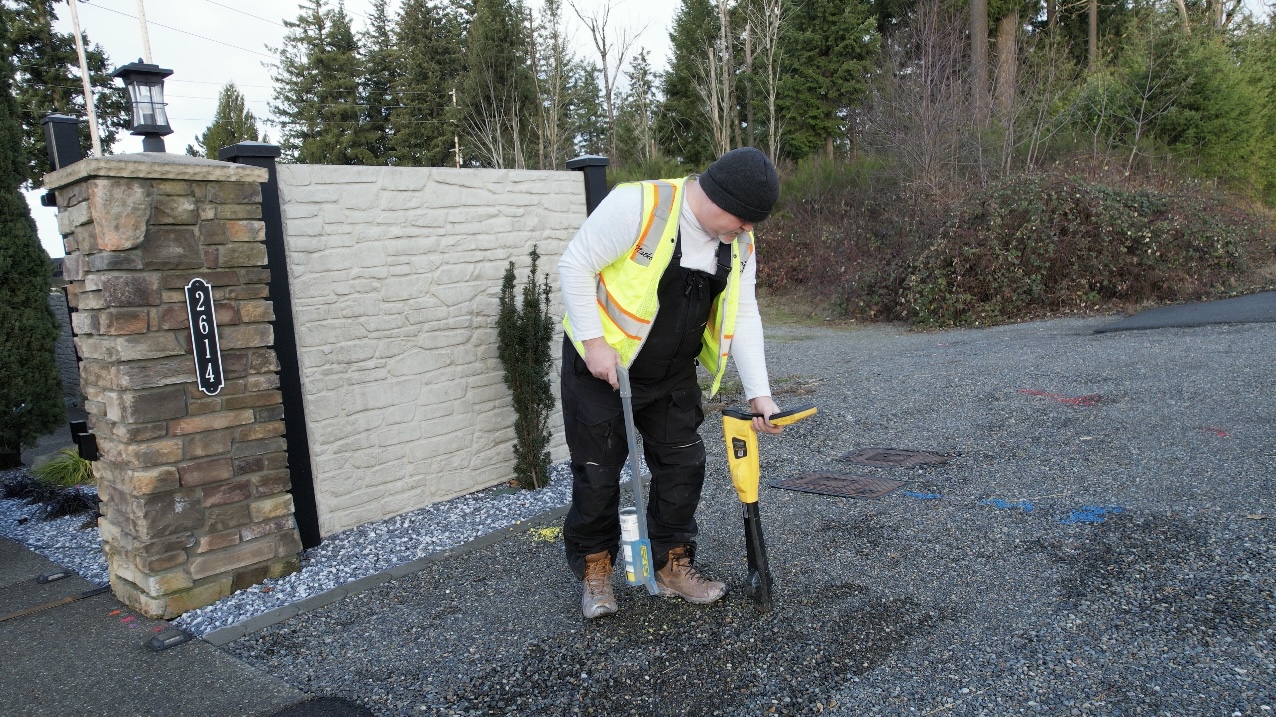
Important Things to Know About Metallic Line Detection
Metallic line detection (electromagnetic detection) is the process where utility locators detect electromagnetic (EM) signals radiating from metallic cables, pipes, and wires. Our equipment emits a radio frequency signal that induces an electrical current in the metallic line, which creates a magnetic field that the receiver can detect. By analyzing the strength and direction of the signal, the location and approximate depth of the metallic line can be determined. These signals can be generated by an electromagnetic transmitter applying current to the cable, pipe, or wire, or the signal can result from current flow in a live electrical cable (power mode), communication transmissions (radio or catv mode), or cathodic protection on a utility (cps mode). These signals can also result from bleed offs on nearby conductive utilities re-radiating signals from stray electromagnetic fields.
It is important to use peak and null modes to identify distorted fields. The horizontal antennas in the electromagnetic receiver detects the electromagnetic (EM) field in peak mode, the EM signal will be the strongest when centered on the field because more of the field passes through the antenna. The vertical antenna detects the EM field in null mode, the field will not pass through the antenna when the vertical antenna is positioned over the center of the field. If the EM field has no distortion, then peak and null signals will correlate and provide the same location.
Metallic line detection is a vital service on every utility locate that CNI Locates provides. It can also be used in conjunction with our other services to provide more accurate results.
Different Methods of Metallic Line Detection (Active & Passive)
Active detection involves using electromagnetic transmitters that send a signal into the ground, which is then detected by a receiver. This method detects metallic lines that are not energized or carrying a current. The active method is more commonly used than the passive method because it is more reliable and detects a wider range of metallic utilities. CNI Locates provides three different active methods to locate conductible/metallic utilities.
- Direct Connection: Direct connection (clipping) directly to the pipe will give you the best signal on a utility. We recommend that our technicians remove bonds on the utility if it shares a common ground with other utilities to get the most accurate signal and to reduce bleed offs or distortion on other utilities.
- Signal Clamp: If our technicians do not have direct access to clip onto a utility (direct connection), we will clamp (signal clamp) the utility from an accessible location. Signal clamps provide great signals and are extremely useful for locating accessible cables, conduits, communication drops, power risers, wires, etc.
- Induction: If our technicians do not have access to provide a direct connection or a signal clamp on the utility, we will provide induction on the utility as a last resort. Induction sends an electromagnetic signal into the ground beneath our electromagnetic transmitters. Induction is the least accurate method of active locating but sometimes it is the only option to locate a utility. Induction is also crucial when providing a sweep for unknown utilities in a work area.
Passive detection involves detecting energized metallic lines that carry a current, such as active power lines, communications, systems with cathodic protection, etc. Passive detection receivers use a magnetic field sensor that detects the magnetic field created by the current flowing through the metallic line. Furthermore, this method is less reliable than active detection because it can only detect energized metallic lines and is affected by the strength and direction of the current flow. CNI Locates uses multiple passive methods to identify metallic/conductible utilities.
CATV: Detects cable tv signals on most buried television conductors.
CPS: Detects most cathodic protection signals that are used to control corrosion on pipes.
Power: Detects 50Hz to 60Hz signals present on most buried electrical conductors.
Radio: Detects re-radiated radio signals present on most buried communication conductors.
Limitations/ Distortions
Metallic line detection (electromagnetic detection) does have limitations. The magnetic field (electromagnetic signal) radiating from underground utilities can be distorted by the presence of adjacent metallic conductors/utilities or other signals.
Some common reasons for this are commonly bonded structures, poorly positioned ground (too close to the transmitter), and signals induced from the target utility to other utilities. This distortion results in the electromagnetic receiver detecting electromagnetic signals from more than one source. It’s important to remember that distortion can cause inaccurate depths and inaccurate locations of utilities, but it can also help find unknown utilities/signals you may not have access to in a work area. Peak mode should always be more accurate than the null. We suggest to use the peak mode for locating and the null mode only to identify distortion.
Our electromagnetic receivers also have the ability to combine peak and null modes at the same time. This mode allows our technicians to track the proportional arrows to place the electromagnetic receiver above the null point or to locate the signal strength of the peak response. If the peak response and null point do not correlate then there is evidence of distortion in the field. If the peak response is at its maximum strength where the null point is located, then there is no or very limited distortion present. After checking for distortion, we suggest to use peak mode to obtain depth and current information.
Ability To Provide Depth Assessments
Metallic line detection (electromagnetic detection) equipment can provide an estimated depth of underground utilities. However, the accuracy of depth assessments can vary depending on several factors, including the type of equipment used, the soil conditions, the size and shape of the utility, and the skill and experience of the operator. We suggest not to rely on depth measurements if they are made close to bends in the utility, close to the transmitter, close to a “T” in the utility, where field distortion has been identified, where the line changes in depth, or when using power mode. All the factors above can result in inaccurate depth & current readings. Three things to check for when obtaining depths are they should be reasonable (If it says 80+’ deep, it can be ignored), repeatable (depth readings should be fairly consistent when they are taken over an area of 10’ to 20’), and there is no congestion (do not take depth readings when an EM field could be interfered with or distorted). Once a depth reading is obtained with the electromagnetic receiver on the ground, we suggest moving the receiver vertically (upward) 1’ to verify the depth changes (e.g., if the depth reading says 3’ and you move the receiver vertically (upward) 1’ the new depth should say 4’). Depth readings are measured to the center of the field. Thus, depths are measured to the center of a utility, not to the top of a utility. EM equipment can typically provide a depth estimate within a few inches to several feet, depending on the signal’s strength and the utility’s size, because of these limitations we suggest that our technicians provide a 30% (or occasionally more) buffer on their electromagnetic depth readings.
Non-Metallic/Non Conductible Utilities
When locating underground utilities there are different strategies for detecting metallic versus non-metallic utilities. Electromagnetic signals do not have the ability to locate non-metallic/non conductible utilities with out the assistance of inserting those utilities with something metallic or something that produces an electromagnetic signal (e.g., flexrod, flexitrace, steel fish tape, tracer wire, sonde, video pipe inspection camera, etc.)
Nonmetallic lines may also need to be detected with ground penetrating radar, non-metallic pipe detection (inserts), plastic pipe detection, or a video pipe inspection if they are not able to be located electromagnetically.
How Metallic Line Detection Compliments Other Services.
Metallic line detection (electromagnetic detection) compliments every service that CNI Locates provides. It can be used in conjunction with ground penetrating radar to verify the location and depth of utilities, to locate a metallic water service or the utilities around that service so our leak detection specialists can provide professional leak detection services and help protect the integrity of the other utilities around the leak, to locate electrical lines or other utilities around that line so we can identify where the line is damaged underground with our electrical fault detection services and protect the integrity of the other utilities in the area when exposing the fault, to mark utilities for our utility mapping and aerial drone imagery services, to identify private and public utilities, to locate metallic/conductible utilities when we are performing concrete and structural scanning services, to assist our magnetic detection services to help find buried manholes, vaults, valve covers, meters, handholes, etc., and so much more.
While metallic line detection equipment is a powerful tool for locating buried utilities, it may not always be sufficient to provide a complete picture of the subsurface. Other complementary services (e.g., ground penetrating radar, non-metallic pipe detection, plastic pipe detection, video pipe inspections, utility mapping, etc.) may be required to get a comprehensive understanding of the site conditions and the location of underground utilities. We suggest combining other methods with metallic line detection for optimum results.
Get Professional Metallic Line Detection Services from CNI Locates!
Metallic line detection combined with our other underground utility locating services can provide a completer and more accurate picture of the location of underground utilities. The information can be used to help plan construction projects, avoid utility damage, and ensure the safety of workers and the public. We suggest you use professional underground utility detection and inspection services from C-N-I Locates LTD for conducting reliable utility locates.
C-N-I Locates LTD offers a wide range of underground inspection services and utility locating services, complemented by our expert technicians. Our comprehensive services include reliable drone imagery services, utility mapping, design survey locating, ground penetrating radar, electrical fault detection, magnetic detection, leak detection, plastic water pipe detection, non-metallic pipe detection, structural and concrete scanning, public and private utility locates, sophisticated reports, sewer crawler inspections, video pipe inspections, and much more across Oregon and Washington State.
Do you have any inquiries about our services? You can get in touch with us through email at [email protected] or call us at (877)826-1177. We are happy to provide you with answers to any questions about our professional services.