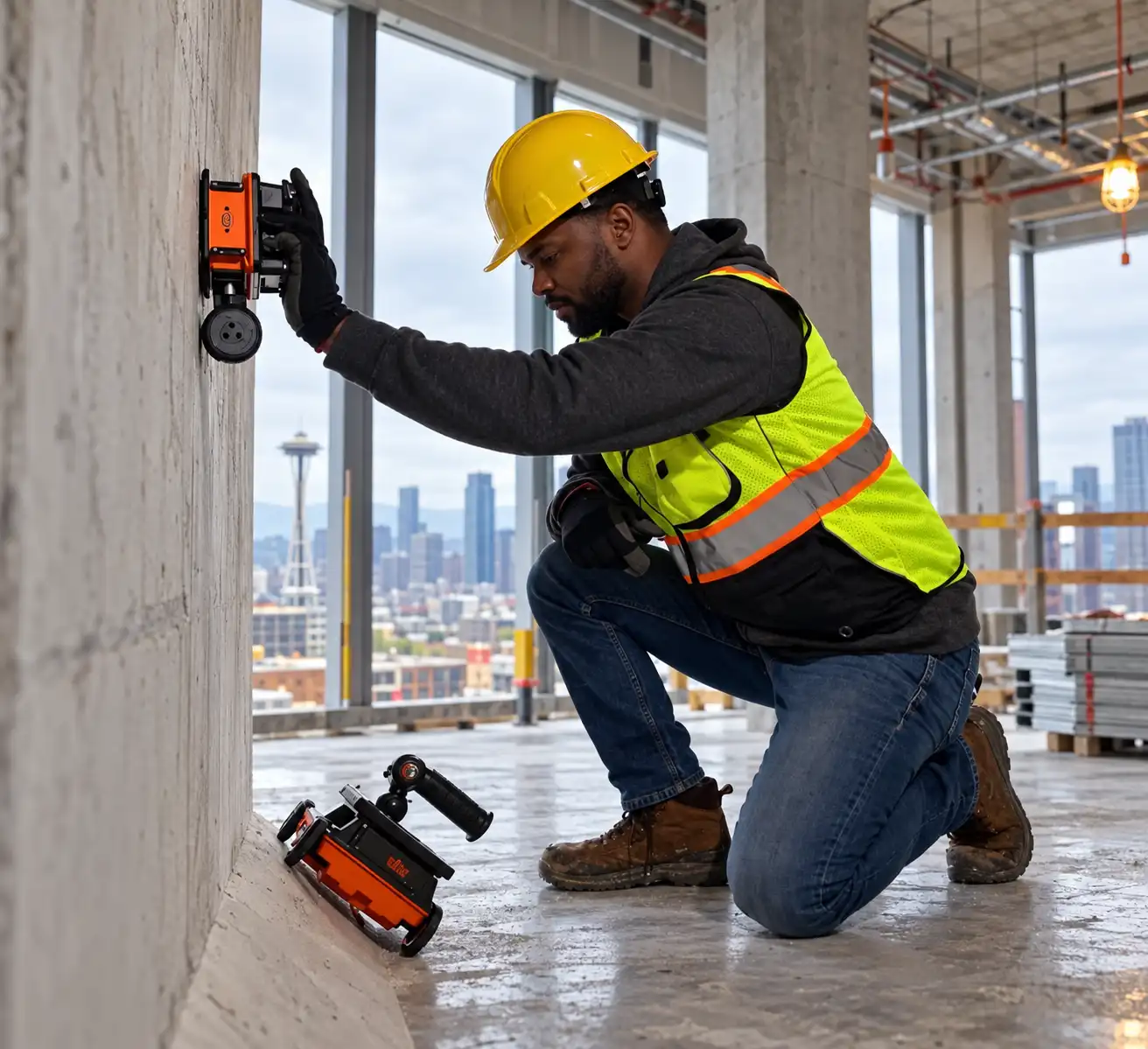
Concrete never shows what is happening inside. A slab can look clear even when rebar, post-tension cables, conduits, voids, or other embedded features are present. This matters anytime there is drilling, coring, anchoring, cutting, or demolition included in the project. GPR concrete scanning provides a way to gather information about the concrete before it is disturbed.
Why Does Concrete Scanning Matter Before Work Begins?
Concrete is not as simple as it looks. Due to renovations, repairs, or expansions over the years, there are changes that may not be obvious from the surface, and available drawings might not be enough to capture every bit of detail. Before drilling, cutting, coring, or other work begins, understanding what lies beneath the surface is more important than one can imagine.
GPR helps in identifying the unseen layer. The technology sends electromagnetic signals into the concrete and records the responses as the antenna moves across the scanning area. Technicians study those responses to understand the potential features within.
Depending on the material and conditions, scanning offers information including:
- Rebar and reinforcing steel
- Post-tension cables
- Metallic and non-metallic conduits
- Voids and cavities
- Beams and other embedded structural features
- Concrete cover and slab characteristics
Concrete and structural imaging services are designed for surfaces such as slabs, walls, columns, beams, and foundations, making the technology useful across a range of existing structures. The real advantage of Ground Penetrating Radar Scanning is timing. Information collected before opening the concrete can be considered before a drill, core, saw, or anchor changes the structure.
Where Can GPR Add Practical Value?
Scanning is most valuable when a simple task meets an unknown condition. A site may look normal from above while a lot is going on under it. Concrete scanning can support planning for:
- Core drilling: Reviewing a proposed opening before coring begins.
- Anchoring: Gathering information before installing anchors or fasteners.
- Saw cutting: Examining planned cutting areas for potential embedded features.
- Renovation: Investigating existing concrete before modifications take place.
- Demolition: Gathering additional information before concrete is removed.
For projects that require this type of investigation, GPR scanning can provide useful information before work begins. The purpose is not to make the decision for the project team. It is to add information to the decision-making process while there is still time to consider it.
Why Does Professional Interpretation Matter?
GPR is a powerful technology but it is not a crystal ball. It works kind of like a bat’s echo location by sending out a signal and recording whatever is reflected. Concrete for example will allow the signal to penetrate up to a different depth compared to clay soil or gravel, and within the slab, things like rebar would not allow the wave to go through at all. Not to mention the weather and temperature also affect how a signal is propagated through a medium.
Several conditions can influence what technicians collect and how they interpret it:
- Reinforcement density and spacing
- Concrete composition
- Electrical and moisture properties
- Surface accessibility
- Obstructions along the scanning path
- Construction methods
- Radar attenuation and signal behavior
Good concrete scanning requires more than just equipment. It needs suitable scanning techniques, correct equipment selection, careful interpretation, and clear communication about conditions that may influence the available information. In practical terms, the equipment gathers the responses. Professional judgment gives those responses meaning.
Conclusion
What lies within concrete can matter long before the first cut is made. GPR offers a practical, safe and effective approach for collecting information about the features and potential conditions before drilling, coring, anchoring, cutting, or demolition begins. With our concrete and structural imaging services, CNI Locates LTD helps clients obtain and understand subsurface information while providing clarity for both the value and limitations of GPR technology.