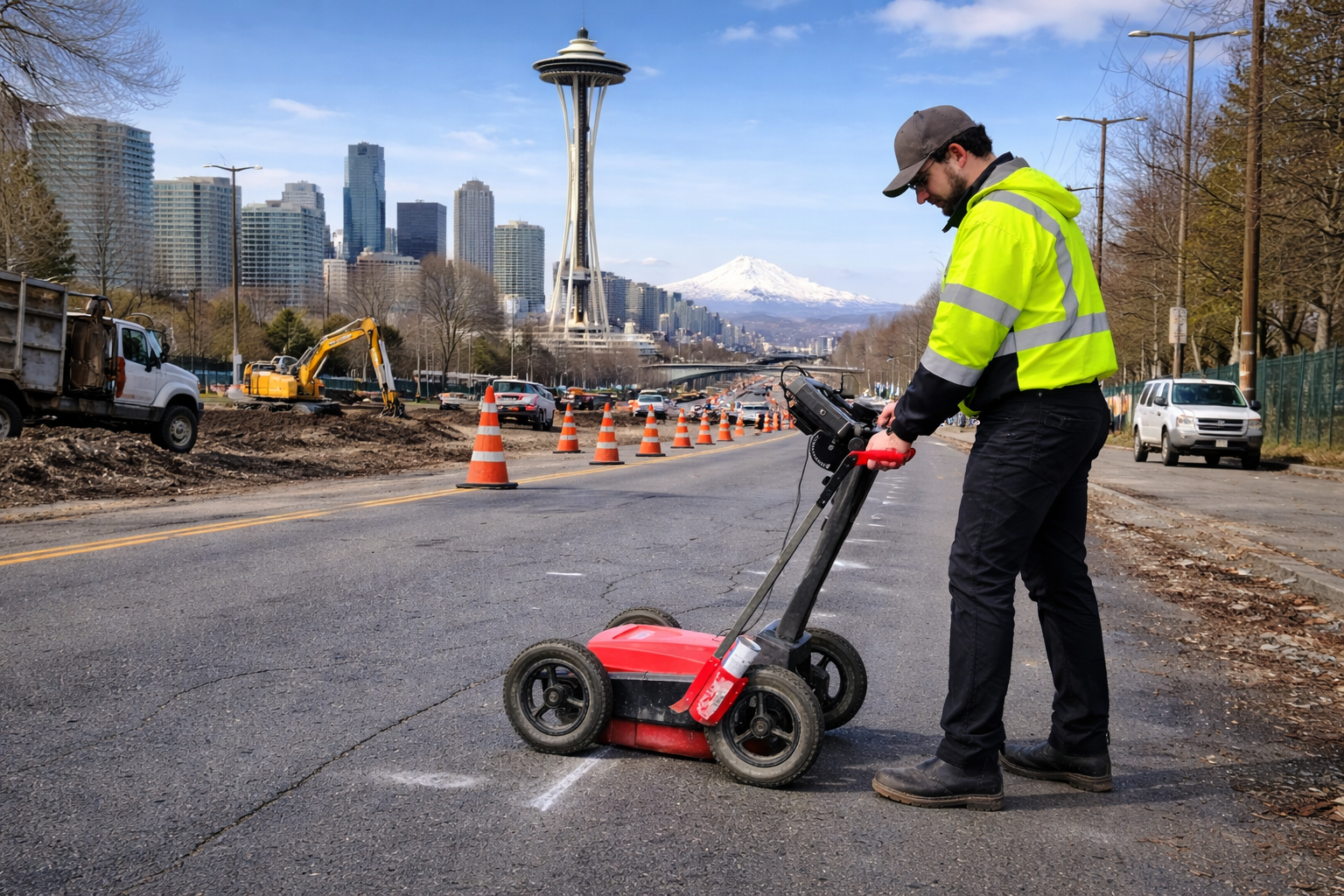
All excavation and construction projects in Washington require their planners to comprehend all potential underground elements that might exist beneath the project site. Underground utility systems that remain unidentified create dangerous conditions by causing unanticipated project delays and incurring extra expenses without proper preparation. The planning process utilizes utility locating services to create a better underground utility assessment before construction work begins.
Before beginning any excavation, property owners and contractors are required to contact 811 in accordance with RCW 19.122, Washington’s underground utility damage prevention law. It is important to understand that 811 typically identifies public utilities and may not include private infrastructure. Because of this limitation, additional investigation may be necessary depending on site conditions and project requirements.
What Early Utility Locating Helps Identify
Early subsurface investigation allows project teams to better understand potential underground conflicts before construction begins. While no method can identify every condition, locating services may help highlight areas where utilities or anomalies are present.
Technicians evaluate each site individually and apply appropriate tools based on accessibility, soil conditions, and utility type. The goal is not to guarantee complete detection, but to improve overall awareness and reduce the likelihood of unexpected discoveries during excavation.
Limitations of 811 and the Need for Additional Investigation
Although 811 is a critical first step, it does not always provide a complete picture of subsurface infrastructure. Public utility locates may not include privately owned systems such as building service lines, private sewer laterals, irrigation systems, or privately installed electrical conduits.
In many cases, a private utility locating service in Washington may be used to help investigate these additional systems. Property owners are responsible for confirming whether utilities are public or private when planning excavation activities. Understanding this distinction early can help reduce uncertainty and avoid project interruptions.
Cost Impacts of Unknown Utilities
Encountering unmarked utilities during excavation can lead to several cost-related challenges, including project delays, repair expenses, and potential safety hazards. These impacts often arise when subsurface conditions are not fully understood prior to construction.
Early planning allows teams to make informed decisions about excavation methods, equipment usage, and site access. While locating services cannot eliminate all risks, they may help reduce the likelihood of unexpected conditions that could affect project timelines and budgets.
Technologies Used to Improve Subsurface Visibility
No single locating method is effective in every environment. For this reason, technicians often combine multiple technologies depending on site conditions and client approval.
One commonly used method is ground penetrating radar utility locating, which can help identify subsurface anomalies and non-conductive utilities. This is often used alongside electromagnetic locating, which is more effective for conductive utilities such as metallic pipes and cables.
Additional tools may include magnetic detection for ferrous objects, tracer rods or sondes for non-metallic lines, and acoustic detection for water systems. Each method has limitations, and its effectiveness depends on factors such as soil composition, depth, and site accessibility.
Why Combining Methods Matters
Because subsurface environments vary significantly from one site to another, combining multiple locating techniques often provides a more complete understanding than relying on a single method. Technicians assess conditions in the field and determine which combination of technologies may be appropriate.
This layered approach allows findings to be cross-checked and may help identify inconsistencies or gaps in data. However, results are always influenced by site conditions, and complete accuracy cannot be guaranteed.
Conclusion
Early planning plays a critical role in managing excavation risk and controlling project costs. By identifying potential subsurface conflicts in advance, project teams can make more informed decisions and reduce the likelihood of unexpected disruptions. A utility locating service may be used as part of this process, while a private utility locating service in Washington can help address infrastructure not covered by 811.
Technologies such as ground penetrating radar utility locating are often combined with other methods to improve visibility, though all techniques have limitations, and results depend on site-specific conditions. Following RCW 19.122 requirements and contacting 811 before excavation remains essential for public utility identification.
C-N-I Locates Ltd. provides subsurface investigation support using a combination of technologies tailored to site conditions, helping clients approach excavation with greater awareness while maintaining realistic expectations about the limitations of utility locating practices.