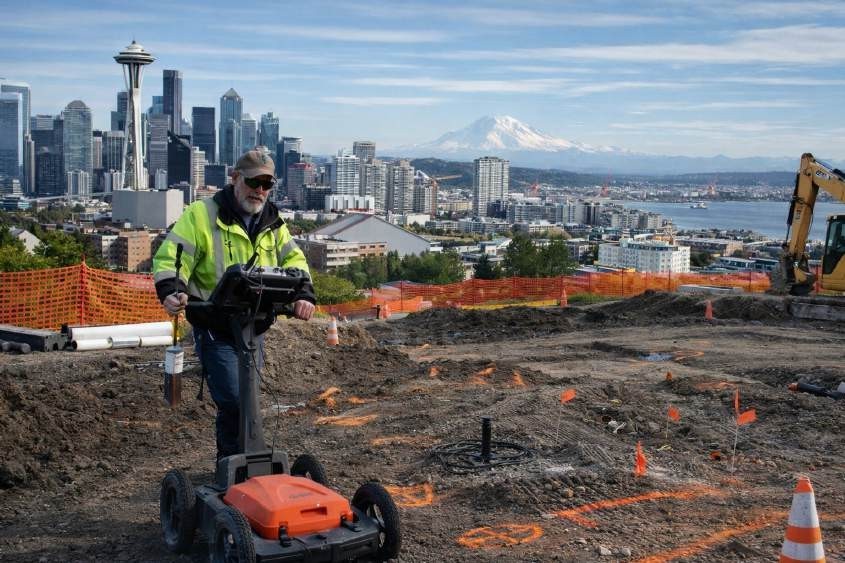
Subsurface utility awareness plays a critical role in safe excavation, planning, and construction activities across Washington State. Before any digging begins, understanding what lies beneath the surface helps reduce the risk of damage to underground infrastructure and supports informed decision-making. While public utility locates are initiated through the 811 system, they may not always identify all underground utilities, particularly privately owned lines. This is where a utilities locator in Washington can assist by providing additional subsurface visibility using specialized detection methods. Professional utility locating focuses on identifying and documenting underground infrastructure while acknowledging that site conditions, access, and utility materials can influence detection outcomes.
What 811 Utility Locates Actually Cover
In Washington State, property owners and contractors are required to contact 811 before excavation in accordance with RCW 19.122. The 811 system is designed to coordinate the marking of public utilities, such as municipal water, gas, and electrical lines.
However, it is important to understand that 811 locates may not include privately owned infrastructure. These can include:
- Building service lines
- Private electrical feeds
- Irrigation systems
- Sewer laterals
- Private water lines
Because of this distinction, relying solely on 811 may leave gaps in subsurface awareness. A utilities locator in Washington may be used to help identify additional underground infrastructure that falls outside the scope of public utility marking.
Understanding Service Limitations in Utility Locating
Professional utility locating is based on the use of various technologies, each of which has operational and environmental limitations. Factors such as soil composition, utility material, depth, congestion, and site accessibility can all influence detection results.
Rather than presenting locating as a fixed or guaranteed outcome, professional locators evaluate site conditions and apply appropriate methods based on those variables. Depth assessments, when provided, are considered approximate and may vary due to signal distortion or changing ground conditions.
This risk-aware approach ensures that expectations remain realistic while supporting safer excavation planning.
Why Private Utility Locating Is Often Required
Private utility locating is often necessary when working on properties where undocumented or privately installed infrastructure may exist. Unlike public utilities, private lines are not always recorded or marked through 811 services.
This is where advanced methods, such as ground penetrating radar utility locating in Washington, can assist in improving visibility of subsurface conditions. Ground Penetrating Radar (GPR) uses subsurface imaging to identify anomalies that may indicate the presence of utilities or other buried features.
However, GPR performance depends on several factors, including soil type, moisture content, and the depth of the target. As a result, it is typically used as part of a broader detection strategy rather than a standalone solution.
Infrastructure Complexity and Real-World Site Conditions
Underground environments can vary significantly from one site to another. Urban areas, in particular, may contain congested utility corridors with multiple overlapping lines installed at different times.
In such scenarios, professional locators assess available access points, review site conditions, and apply detection methods accordingly. Technologies such as electromagnetic locating, magnetic detection, and subsurface imaging may be used in combination to improve clarity.
A GPR utility locator in Washington may be involved when non-conductive utilities, such as plastic pipes, cannot be detected using electromagnetic methods. This highlights the importance of selecting the appropriate tools based on the specific conditions of each site.
Technologies Used to Improve Utility Visibility
Professional utility locating relies on a combination of technologies rather than a single method. These tools are selected based on site conditions and project requirements to improve the overall understanding of subsurface infrastructure.
Commonly used methods include:
- Electromagnetic locating for conductive utilities
- Ground Penetrating Radar for subsurface imaging
- Magnetic detection for ferrous objects
- Acoustic detection for pressurized pipes
- Video camera inspections for internal pipe tracing
These technologies are often used together to confirm findings and address the limitations of individual methods. For example, ground penetrating radar utility locating may be used alongside electromagnetic locating to improve the detection of both conductive and non-conductive utilities.
Similarly, a GPR utility locator may assist in identifying subsurface anomalies in areas where traditional locating methods provide limited results.
Conclusion
Professional utility locating is defined by a structured, risk-aware approach that prioritizes accuracy, safety, and clear communication. By understanding the differences between public and private utilities, acknowledging service limitations, and applying multiple detection technologies, utility locators help improve subsurface awareness before excavation begins.
No single method can identify every underground condition, which is why combining technologies based on site variables is essential. From electromagnetic locating to advanced imaging techniques, each method contributes to a more complete understanding of what may exist below the surface.
For projects across Washington State, C-N-I Locates Ltd. provides utility locating and subsurface investigation services designed to support contractors, engineers, and property owners with informed planning and safer excavation practices.