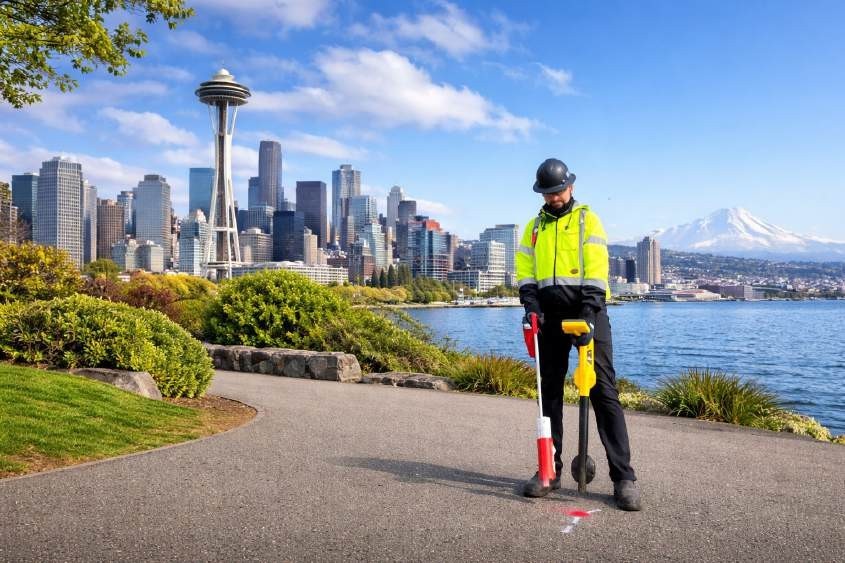
Construction projects involve a high level of coordination, planning, and risk management, especially when excavation is required. Before any ground is disturbed, it is critical to understand what lies beneath the surface to reduce the risk of utility damage and safety hazards. While the 811 system plays an essential role in identifying publicly owned utilities, it may not include privately owned infrastructure. This is where a private utility locator becomes an important part of the pre-construction process.
In Washington State, all excavation activities must comply with RCW 19.122, which requires contacting 811 before digging. However, since 811 typically marks public utilities only, additional investigation may be necessary to identify private lines. Technicians evaluate site conditions and apply appropriate methods to improve subsurface visibility, recognizing that results depend on site-specific factors and conditions.
What 811 Utility Locates Actually Cover
The 811 system is designed to help prevent damage to publicly owned underground utilities prior to excavation. This typically includes services such as public water mains, electrical distribution lines, gas pipelines, and communication infrastructure.
However, it is important to understand that 811 locates do not usually include privately owned utilities. These may consist of service lines running from the meter to a building, private sewer laterals, irrigation systems, or privately installed electrical feeds. Because of this limitation, relying solely on 811 may leave certain subsurface conditions unidentified.
To address these gaps, many projects incorporate a utility locating service that focuses specifically on identifying private infrastructure. This additional step helps provide a more complete understanding of underground conditions before excavation begins.
Why Private Utility Locating Is Often Required
Private utility locating plays a critical role in construction planning by helping identify infrastructure that may not be covered through standard utility marking systems. Since private utilities vary widely in material, depth, and installation methods, their detection often depends on site conditions and available access points.
A private locating service approach allows technicians to investigate areas where unknown or undocumented utilities may exist. This can be particularly important on older properties, redevelopment sites, or locations with previous modifications.
It is important to recognize that no locating method can guarantee the identification of all underground utilities. Instead, technicians use a combination of experience and available technologies to improve visibility, while acknowledging that some limitations may remain due to soil conditions, utility materials, or site constraints.
Sewer Laterals and Private Infrastructure Considerations
Sewer laterals are a common example of private infrastructure that may not be included in standard utility locates. These lines connect buildings to municipal sewer systems and are typically the responsibility of the property owner.
Because these utilities are often non-conductive and may not have tracer wires, locating them can require specialized methods. A private utility locator in Washington may use tools such as push cameras with sondes or sewer crawler systems to trace the path of these lines from within the pipe.
In many cases, the ability to identify sewer laterals depends on accessibility, pipe condition, and environmental factors. As with other locating services, results can vary, and exact depth or alignment may not always be fully confirmed.
Technologies Used to Improve Utility Visibility
Subsurface investigation typically involves the use of multiple complementary technologies rather than relying on a single method. Each tool has specific strengths and limitations, and technicians select combinations based on site conditions.
A utility locating service in Washington may include electromagnetic locating (EM) for conductive utilities, ground penetrating radar (GPR) for detecting subsurface anomalies, and magnetic detection for identifying ferrous objects. For non-conductive utilities, tracer rods, sondes, or acoustic methods may be used.
These technologies are often applied together to confirm findings and improve overall accuracy. However, their effectiveness depends on variables such as soil composition, utility material, depth, and site accessibility. For this reason, results are always interpreted within the context of site conditions.
Conclusion
Understanding the role of private utility locating is essential for improving safety and awareness on construction sites. While 811 remains a critical first step for identifying public utilities and complying with RCW 19.122, it may not provide a complete picture of all underground infrastructure. Property owners and contractors should always verify whether utilities are public or private before excavation begins.
By incorporating private locating services in Washington, projects can address gaps in utility information and reduce the risk of unexpected conflicts during construction. Since no single method can detect all utilities, technicians often combine multiple technologies to adapt to site-specific challenges and improve reliability.
Careful planning, proper investigation, and a clear understanding of service limitations all contribute to safer excavation practices. Working with experienced professionals like C-N-I Locates Ltd. supports informed decision-making and helps ensure that subsurface conditions are evaluated with a structured, risk-aware approach.