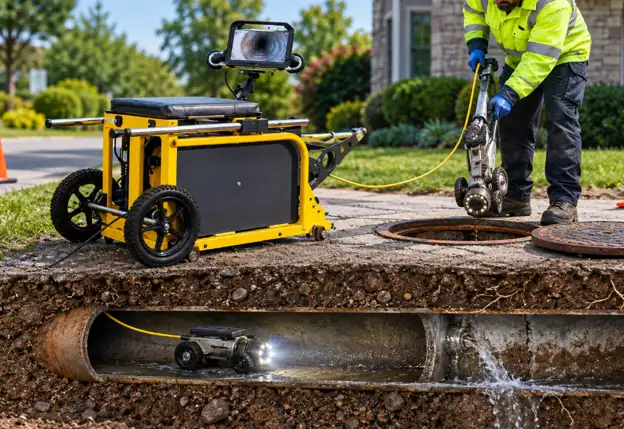
An underground water line or sewer pipe may cause issues before any evidence of damage appears. It could be that the meter is still running after everything has been turned off. It could be that one drain now takes longer to clear. Or it could be that there is a patch of ground that is wet when all the others are dry. Sewer leak detection can help by gathering these clues and initiating a deeper investigation into what is beneath the surface.
But the thing is, the evidence of the problem is not necessarily its origin. Water that leaks out can travel through the soil. A damaged sewer pipe can lie underground, under pavement, under landscaping, or even inside a building.
What Can a Leak Tell You?
The first clues usually come from changes that were not there before. Watch for:
- A water meter that moves when fixtures are off
- Water use that suddenly increases
- Unexplained wet or soft ground
- A drop in water pressure
- Running or hissing sounds with no water in use
- Slow drains or repeated backups
- Persistent sewer odors
- Unusual plant growth over one area
- Damp or discolored floors and walls
- Changes in nearby pavement or ground
A sewer leak can result from cracks, damaged joints, root intrusion, or other pipe defects. A surface symptom rarely tells the whole story. Water may travel before it appears, and a sewer defect may remain entirely inside the pipe. That is why inspection matters.
Which Methods Can Find the Problem?
Different problems call for different ways of looking.
Video Inspection
If the pipe is open, a camera could go in for a closer look. Pipeline Video Inspection can reveal visible problems such as cracks, roots, clogs, damage, and other issues that cannot be observed from the outside.
Push cameras can survey small pipes, while larger ones can use crawler cameras. The images document the pipeline interior and the survey conditions.
Acoustic Detection
Pressurized water produces noise as it leaks. An acoustic device can detect vibrations at appropriate entry points or above the underground pipe.
The signal is different from location to location. The pipe material, diameter, pressure, depth of burial, soil type, and cover all affect sound propagation. The same leak under concrete acts differently from one under loose soil.
Leak Correlation
Correlation uses sensors placed at appropriate points along the water pipe. Rather than relying on a single listening location, the process will measure when the signal arrives at different sensors. This will help limit the scope of the investigation.
Thermal imaging and tracer gas detection are other techniques that may prove helpful in certain situations. Different approaches offer different perspectives on the problem, so the appropriate inspection method should be selected based on the specific site conditions and type of pipeline.
How Is the Search Narrowed Down?
The practical answer to finding a Water Leak is not to start digging. It is to work from the broadest clues toward the smallest sensible area.
- Start with the basics: review water use, pressure changes, drainage behavior, odors, moisture, and other observations. These clues establish the starting point.
- Survey the suspected line: For a pressurized water line, technicians can listen at suitable access points such as valves, hydrants, or meters. Comparing signals can help narrow the area that deserves closer attention.
- Focus the investigation: Once a section stands out, use acoustic equipment to examine it more closely. If the conditions call for another approach, thermal imaging, tracer gas detection, or another suitable method may add useful information.
- Look inside sewer lines: A camera changes the investigation entirely. Instead of interpreting surface clues, technicians can view the pipe interior and document what is actually there.
- Record the findings: Footage, photographs, observations, and inspection notes create a useful record of the conditions encountered.
The process is simple in principle: look for the clue, narrow the field, inspect the line, document what you find.
Conclusion
A water or sewer leak can begin as a small clue and become a much bigger problem if it goes unnoticed. Water use, drainage behavior, odors, moisture, acoustic signals, and interior pipe conditions can all tell part of the story.
CNI Locates LTD offers utility detection and inspection services, including leak detection and video pipe inspection. Our team identifies and documents subsurface infrastructure information.