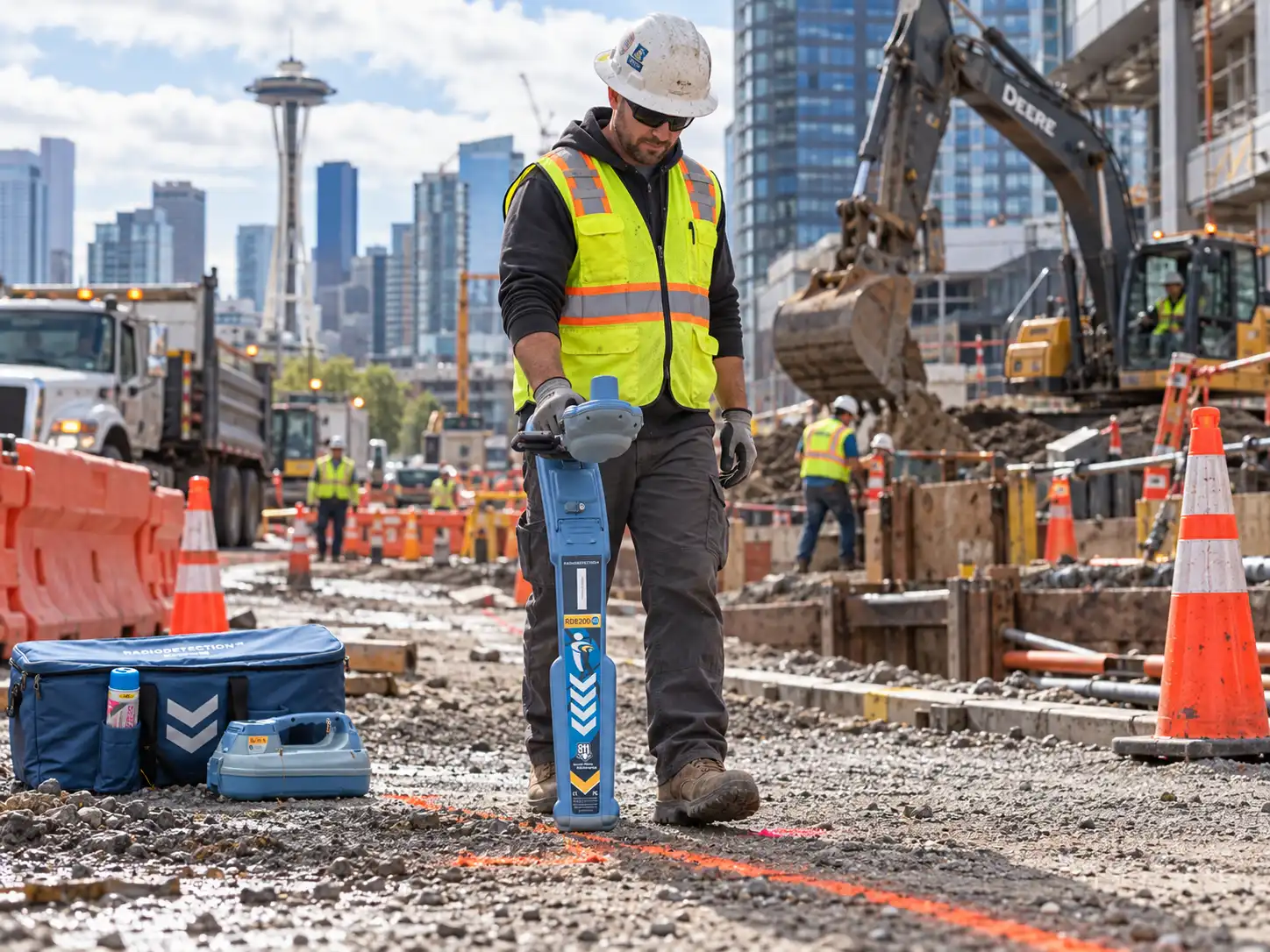
A receiver is not always right. It can light up for all the wrong reasons. That is one of the first things an experienced utility locator learns. A signal may jump from one conductor to another, become distorted near metal, or change because of the way the transmitter and ground are connected. For a private utility locating service, the real challenge is not getting a response. It is deciding whether that response belongs to the utility being traced or whether something else has joined the conversation.
Where Do False Signals Come From?
Underground utilities rarely travel alone. Two or more conductive lines may share a narrow corridor. A transmitter sends energy to one, but a nearby conductor can pick up some of that energy. The receiver then responds to both, even though only one was the original target. That is known as bleed-off.
Metal complicates things more often. Conductive objects like fences, manholes, vaults, and reinforcing steel influence the electromagnetic field. Electrical equipment introduces background interference. Poor connections and grounding can also change the way current travels. The result can look surprisingly convincing.
An experienced technician watches for the little things that do not quite add up:
- Two nearby lines responding to one transmitter
- A signal changing near a metallic structure
- Sudden changes in signal strength
- A route that does not fit the surrounding layout
- Peak and Null responses that do not agree
None of these signs automatically explains the problem. All they tell the technicians is to slow down. And that pause matters. A questionable signal deserves investigation before anyone treats it as a buried utility.
Reading the Signal Differently
Good locating is not a race from one end of a property to the other. If the response appears to be questionable, then the technician can modify the set-up at one location and see the effect. The signal can be applied using direct connection, a clamp, or induction.
This is where experience becomes visible. A technician might lower the frequency and see whether the unwanted response weakens. They might check the transmitter connection again. They might move the ground farther from nearby conductive features. They might approach the suspected route from another access point.
The technician is essentially asking the signal to behave differently. If it changes in a predictable way, that tells them something. If it suddenly jumps to another conductor, that tells them something else. The receiver gives the response. The technician works out the story behind it.
What Happens When the Site Gets Complicated?
There are properties that make locating feel like trying to follow one conversation in a crowded room. Complicated sites may contain multiple utilities close together, electrical equipment, metallic structures, older infrastructure, difficult grounding conditions, and restricted access. All those can affect the raw data.
Grounding deserves particular attention. A poor connection will decrease the signal that gets to the intended utility. Rust or paint, among others, may affect the connection point. The placement of the ground will determine the path of the current, especially when there is another conductor around.
Knowing When to Change Course
Sometimes the smartest decision is to stop using the same method. Utilities Locating Service can involve different detection approaches because underground infrastructure does not always give an electromagnetic locator something conductive to follow. Depending on the feature and site, technicians may use GPR, magnetic detection, acoustic methods, traceable rods, sondes, or video inspection.
The important part is knowing why a different method makes sense. If a signal keeps transferring between nearby conductors, the technician can investigate that behavior. If the suspected feature does not provide a suitable conductive path, another detection method may offer a better way to gather information.
A careful technician may:
- Recheck the transmitter connection
- Review the grounding arrangement
- Change to a suitable frequency
- Compare Peak and Null behavior
- Check nearby conductors
- Revisit the route from another position
- Use another detection method when appropriate
- Record interference or access limitations
That is how experienced technicians deal with false signals. They do not assume every response is straightforward or correct. They notice when something feels wrong, test the field, look at the surroundings, and change course when the evidence calls for it.
Conclusion
False signals are a part of dealing with underground facilities. Bleed-off, grounding conditions, nearby conductors, metallic objects, electromagnetic interference, frequency, and site conditions may affect what the detector displays. CNI Locates LTD offers services related to the detection and inspection of underground utilities, with attention to the actual challenges of each field environment.