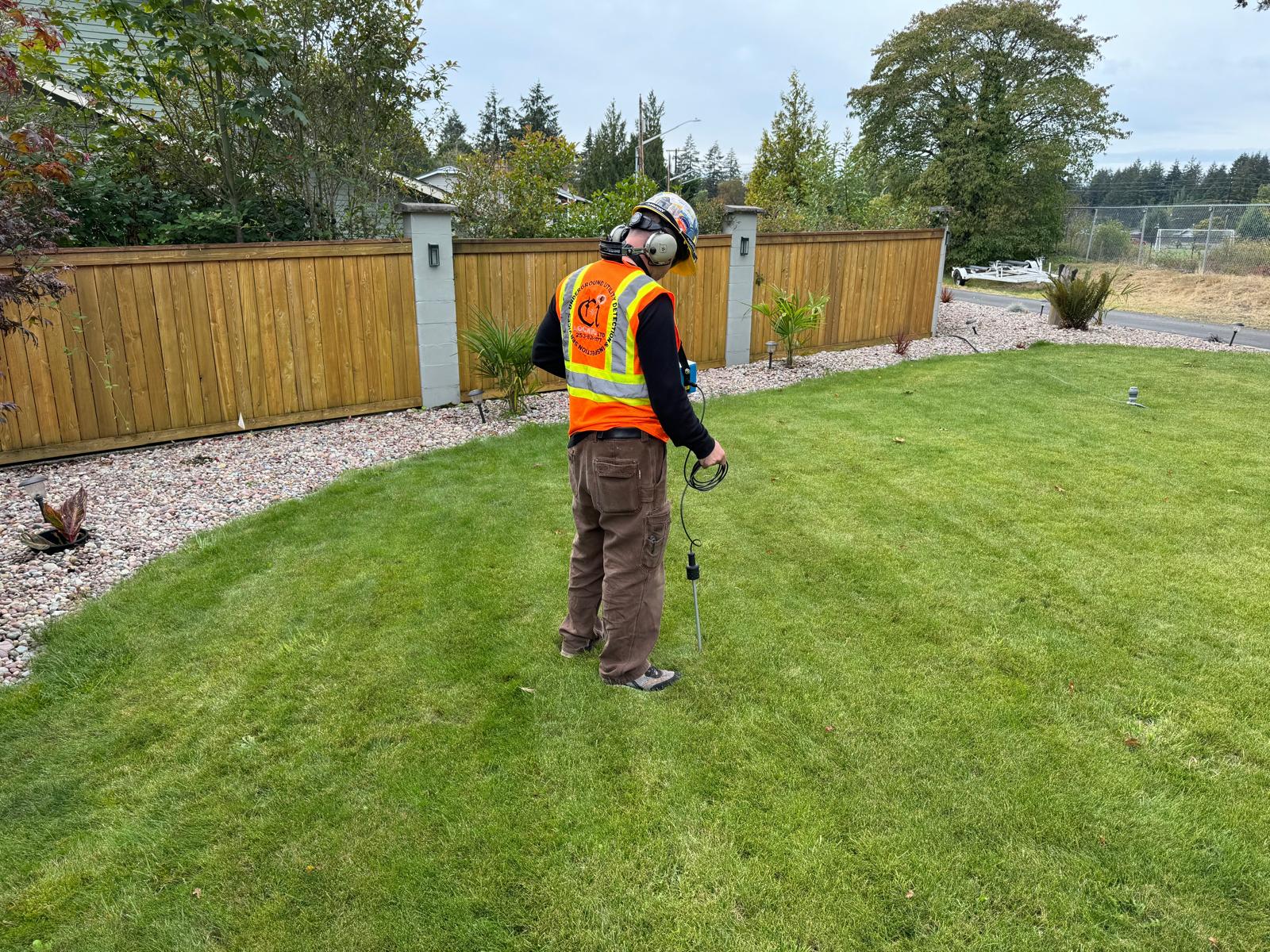
When any new job is set to begin, be it construction, landscaping, or renovation, it is essential to conduct private utility locates to ascertain what lies beneath the surface. Utilities are considered private from the meter on. 811 only marks public utilities, whereas a private utility locator marks private utilities such as water services, power feeds to outbuildings, irrigation, low-voltage systems, and more. Private utility locators also can double check public marks.
Private utility locating technicians undergo extensive training with various types of equipment and methods to protect underground infrastructure from potential damage. This enables contractors, engineers, and property owners to have a much more predictable schedule and budget.
What Tools Do Private Utility Locators Use?
A competent private utility locator depends on sophisticated technologies to identify utilities under the surface. Commonly used methods include the following:
Electromagnetic Transmitters and Receivers
When electromagnetic radio frequency signals are transmitted through conductive utilities such as metal pipes and cables, a receiver follows the peak signal to identify known and unknown underground utilities.
Ground Penetrating Radar (GPR)
GPR transmits a series of radar pulses into the surface to detect a difference in dielectric properties through materials in the subsurface. This helps identify metallic and non-metallic utilities such as PVC water lines, sewer laterals, communication conduits, and more beneath the surface. GPR is a necessary piece of technology in the toolbelt of a modern-day utility locator to enhance safety and accuracy on projects.
Acoustic Pipe Detection
Subsurface microphones are used to detect transmitted vibrations and sounds through nonmetallic pipes to help identify their locations. This technology is excellent for locating plastic water services.
Combining this technology with other services allows private utility locators to provide the most complete subsurface picture, especially when confronted with challenging terrain or congested work areas.
Techniques for an Effective Private Utility Locate
Correct identification is not just about the equipment; it also involves training, planning, and having a systematic approach. The list includes:
• Site Assessment
As-builts, utility maps, and environmental conditions are reviewed for potential conflicts.
• Marking & Labeling Known Lines
Set a baseline before searching for unknown or abandoned utilities.
• Scanning in a Grid or Pattern
Entire areas must be scanned to check for hazards and unknowns.
• Verification & Depth Estimation
Always consider verifying depths and marks with at least two types of technological methods.
Legitimate locating techniques lessen risk, enhancing the safety of subsurface work.
Environmental Challenges to Consider
Every work area has unique characteristics and challenges. A private utility locator should take the following into consideration:
• Soil Type
Ground penetrating radar (GPR) depth can be reduced by clay soils, whereas rocky or sandy soils can cause signal distortion.
• Interference
Metal objects, overhead lines, and grounding systems could affect the readings obtained through electromagnetic methods.
• Accessibility
Obstructions such as shrubs, walls, or limited space may need to be dealt with using unconventional methods.
Experts foresee such situations and change their plan accordingly to ensure precision and safety.
Why Private Utility Locates Matter for Your Project
In the event of an underground mishap, the repercussions may be serious:
- Costly delays
- Damage to essential utilities
- Utility Outages
- Pollution
- Dangers to the workers and the property
Do not hesitate to invest a in a reliable private utility detection and inspection company. A good investment contributes to better planning and safety on projects before you perform subsurface work.
Final Thoughts
Private utility locating incorporates technology, skills of experts, and strategic planning in one discipline. A professional private utility locator employs methods such as electromagnetic locating, GPR scanning, and acoustic pipe detection, which are necessary in keeping a project safe and efficient.
At CNI Locates, we help identify underground utilities with precision. Whether you are a contractor preparing to dig or a property owner maintaining infrastructure, we are here to support your project every step of the way.
Want to make sure your next project gets off to a proper start? Consult with an expert at CNI Locates about our private utility locating services.