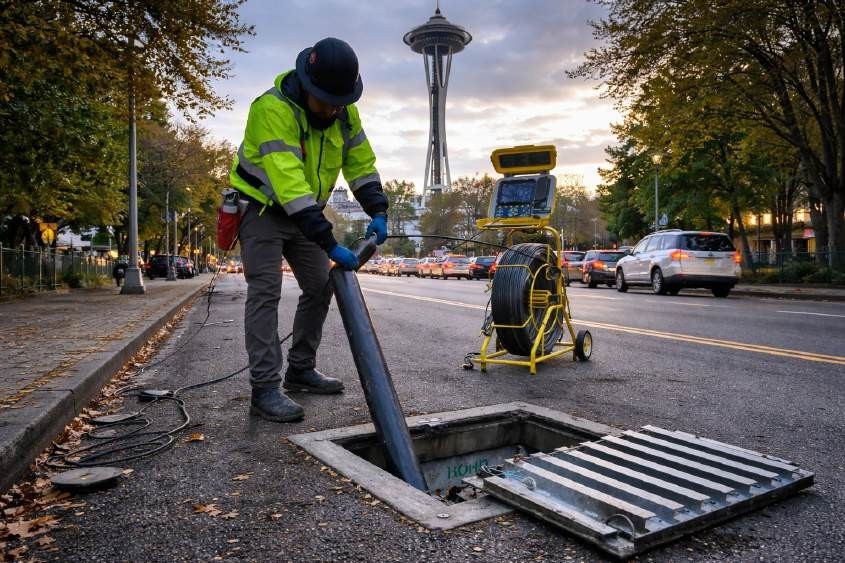
The process of understanding subsurface infrastructure needs to be completed before any excavation, repair work, or construction activities begin. In many cases, internal pipe inspections are used to evaluate the condition and path of underground systems without disturbing the surface. A video pipe inspection in Washington enables operators to view pipe interiors, find blockages, and help with pipe route mapping. The method delivers useful visual information, yet inspection outcomes are contingent on site conditions, pipe accessibility, and equipment capabilities. No single method can fully identify all subsurface conditions. The complete assessment of subsurface conditions requires multiple methods, as inspection technologies perform best when combined with additional detection methods that enhance overall visibility.
The Washington State regulations under RCW 19.122 require all work to contact 811 before starting any excavation activities. The 811 locates identifies public utilities, but it does not include sewer laterals, privately owned service lines, and other private infrastructure elements. The site conditions determine which additional investigation methods need to be implemented.
What Video Pipe Inspections Can Show
Video pipe inspections are designed to provide a visual assessment of internal pipe conditions. Using push cameras or crawler systems, technicians insert equipment into accessible entry points such as cleanouts, manholes, or conduits.
This process may help identify:
- Internal pipe conditions such as cracks, blockages, or buildup
- General pipe alignment and direction
- Obstructions, roots, or debris inside the pipe
- Changes in pipe material or configuration
A video camera inspection can assist in understanding what is happening inside a pipe without excavation. However, visibility is limited to the interior environment of the pipe and depends heavily on accessibility, cleanliness, and pipe condition.
Access and Preparation Limitations
One of the primary limitations of pipe inspections is access. For a successful inspection, the pipe must be reachable through an appropriate entry point. If access points are limited or obstructed, inspection capability may be restricted.
Common access-related challenges include:
- Blocked or buried cleanouts
- Pipes requiring the removal of fixtures for entry
- Limited entry points in older or modified systems
- Obstructions such as debris, grease, or sediment
In many cases, pipes must be cleaned prior to inspection to improve visibility. If preparation is incomplete, the inspection may not provide clear or usable results. These conditions can directly affect the effectiveness of a sewer line camera inspection in Washington, especially in systems with heavy buildup or restricted access.
Depth and Location Constraints
Video pipe inspections are primarily designed to observe internal conditions and do not directly provide surface-level positioning of underground pipes unless additional tools are used.
Limitations include:
- Depth readings may be approximate and dependent on signal tracking methods
- Surface location tracking requires additional equipment, such as sondes or electromagnetic locating tools
- Deep or complex pipe networks may reduce signal clarity
When attempting to determine pipe location, technicians may combine inspection tools with other technologies.
Obstruction and Pipe Condition Challenges
Pipe conditions can significantly affect inspection results. Physical obstructions or structural issues may prevent cameras from traveling through the full length of the pipe.
Common challenges include:
- Sharp bends or junctions that limit camera movement
- Collapsed or heavily damaged pipe sections
- Standing water that reduces visibility
- Debris accumulation is blocking the inspection path
In these situations, a video camera inspection may provide only partial information. Additional methods may be required to continue the investigation or confirm findings in areas that cannot be visually accessed.
Why Multiple Detection Methods Are Often Required
Because video inspections focus on internal visuals, they are often combined with other detection methods to provide a more complete understanding of subsurface conditions.
Technicians may use:
- Electromagnetic locating to trace conductive pipe paths
- Ground Penetrating Radar (GPR) to identify subsurface anomalies
- Acoustic detection or non-metallic pipe detection methods for non-metallic pipes
- Mapping tools to document surface markings
A sewer line camera inspection can contribute valuable insights, but it does not replace other locating technologies. Combining multiple service methods allows technicians to work around site limitations and improve overall visibility when planning excavation or repair work.
Conclusion
Video pipe inspections are a valuable tool for observing internal pipe conditions, but like all subsurface investigation methods, they have operational limitations. Factors such as access, pipe condition, depth, and site variables can influence the results. Understanding these limitations helps ensure that expectations remain realistic and that appropriate methods are selected for each project. In many cases, combining inspection technologies with additional locating services can provide a more complete picture of underground infrastructure. C-N-I Locates Ltd. supports contractors, engineers, and property owners by providing subsurface information that can assist in safer planning and decision-making, while recognizing that all detection methods depend on site conditions and technical limitations.