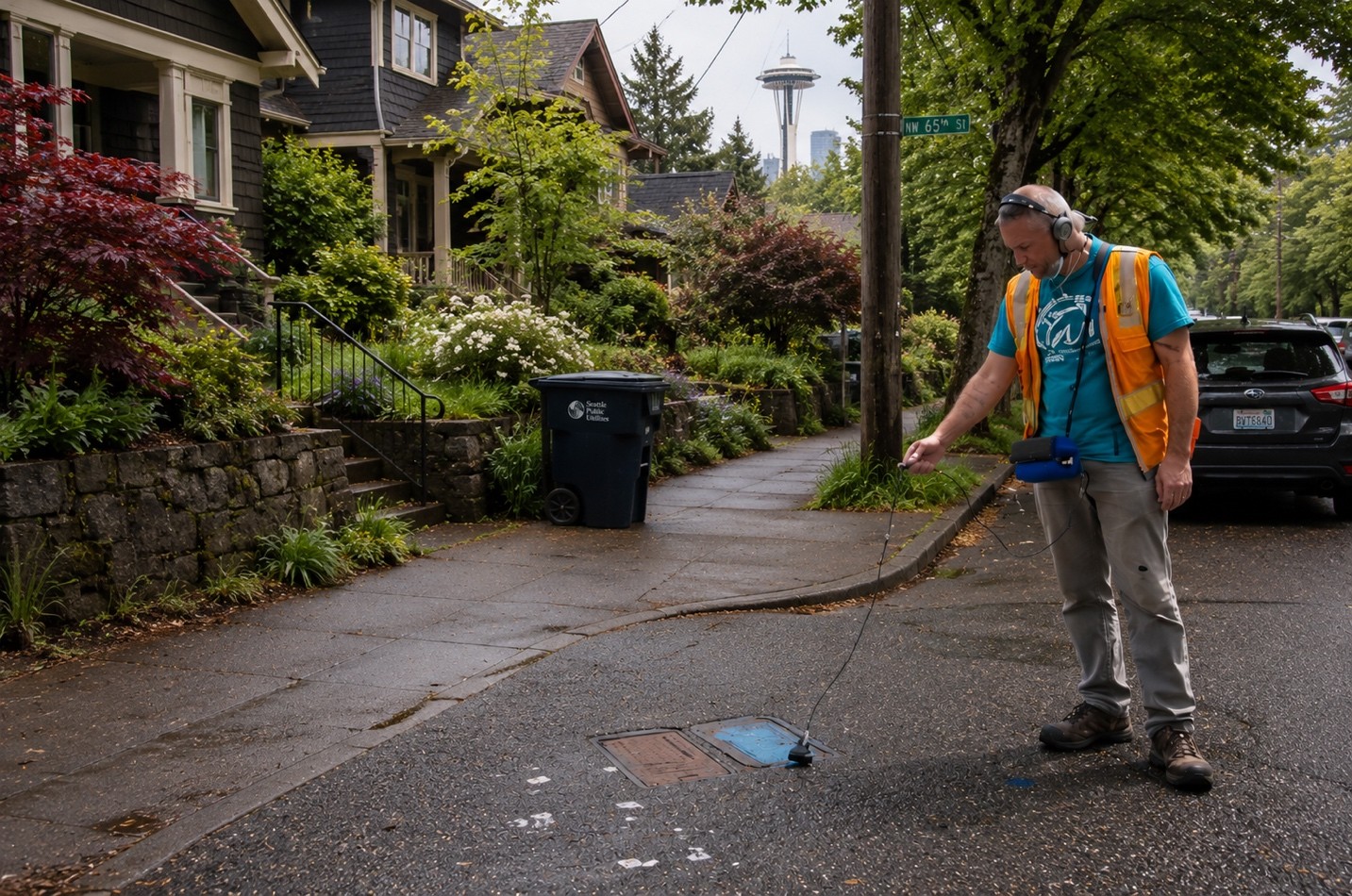
Underground water leaks create major problems that property owners, contractors, and facility managers face, especially when the source of the issue is not immediately visible. The detection of hidden leaks requires specialized tools and methods that enable better underground detection without the need for excavation. Underground leak detection services use acoustic methods, which enable operators to track sound and vibration through pressurized water lines. The methods enable leak detection, but their effectiveness depends on multiple factors, such as site conditions, pipe materials, environmental factors, and more. Leak detection can require multiple service applications because no single method can detect all leak scenarios, and understanding these limitations helps create safe and effective investigation plans.
How Acoustic Leak Detection Works
Acoustic leak detection is based on the principle that pressurized water escaping from a pipe produces sound or vibration. Technicians use sensitive listening devices to detect these noises along the suspected pipe route.
The process typically involves:
- Introducing compressed air within the pipe system
- Using ground microphones or listening sensors
- Identifying areas with higher sound intensity
- Marking probable leak locations based on signal response
This method is commonly used during water leak inspections, especially for pressurized systems where sound transmission can travel along the pipe. However, the strength and clarity of the signal can vary depending on several environmental and structural factors.
Key Limitations of Acoustic Leak Detection
While acoustic methods can assist in identifying potential leak areas, they are subject to several operational limitations that must be considered during any investigation.
Common limitations include:
- Pipe Material
Non-metallic pipes such as PVC or poly pipes may transmit sound less effectively than metallic pipes, making detection more challenging. - Pipe Depth and Distance
Deeper pipes or long service lines can reduce the strength of the acoustic signal, making it harder to isolate the exact leak location. - Pipe Size
Larger pipes can be harder to pressurize with compressed air and may require specialized equipment. - Access
You must have access to the whole path of the pipe to effectively detect a leak. - Environmental Noise
External noise sources such as traffic, machinery, or aircrafts can interfere with acoustic readings and reduce signal clarity. - Path of Least Resistance
Water or compressed air can follow the path of least resistance through tunnels under the ground caused from the water leak. This causes the sound of the escaping air/water to come up away from the actual leak. This is very common on leaks that are on hillsides. - Soil and Surface Conditions
Soil composition, moisture levels, and surface materials like asphalt or concrete can affect how sound travels through the ground. - And More…
Because of these factors, technicians performing underground leak detection services in Washington evaluate site conditions carefully before relying solely on acoustic methods.
Accuracy Considerations and Depth Limitations
Acoustic leak detection provides an estimate of where a leak may be located based on sound intensity, but it does not always indicate the exact position of the pipe or the precise point of failure.
Important considerations include:
- Detection accuracy may vary within a range depending on site conditions
- Peak sound response may not always align directly with the pipe centerline
- Depth information cannot be determined using acoustic methods alone
During a water leak inspection, technicians may explain that results represent the most probable leak location based on available data. Additional verification methods may be recommended when higher confidence is required.
Why Multiple Technologies Are Often Required
Because acoustic detection has inherent limitations, it is often used in combination with other technologies to improve overall visibility and confirm findings.
Depending on site conditions and client approval, technicians may integrate:
- Tracer gas leak detection to correlate the acoustic findings with tracer gas findings.
- Electromagnetic locating to trace conductive utilities
- Ground Penetrating Radar (GPR) to identify subsurface anomalies
- Tracer rods or sondes for non-metallic pipe tracing
- Magnetic detection for identifying buried components
- Concrete or structural scanning for interior systems
A water leak detection company in Washington may combine these methods to overcome detection challenges, particularly when dealing with complex infrastructure or difficult site conditions.
Role of 811 and Utility Verification
Before performing any excavation or subsurface work, it is important to follow Washington State regulations. Property owners and contractors are required to contact 811 to request the marking of public utilities in accordance with RCW 19.122.
However, it is important to understand:
- 811 typically identifies public utilities only
- Private utilities such as irrigation lines, private water services, or building connections may not be included
- Additional investigation may be required to locate private infrastructure
When working with a water leak detection company, verifying whether utilities are public or private can help ensure that all potential risks are properly addressed before excavation begins.
Conclusion
Understanding the limitations of acoustic leak detection is essential for making informed decisions during subsurface investigations. While acoustic methods can help identify potential leak areas, their effectiveness depends on several factors. For this reason, combining multiple technologies often provides a more reliable approach to improving visibility and confirming findings. Following proper procedures, including contacting 811 and recognizing the difference between public and private utilities, plays a critical role in maintaining excavation safety. By focusing on accurate data collection and clear communication of service limitations, C-N-I Locates Ltd. supports contractors, engineers, and property owners in making safer and more informed decisions when addressing underground infrastructure concerns.