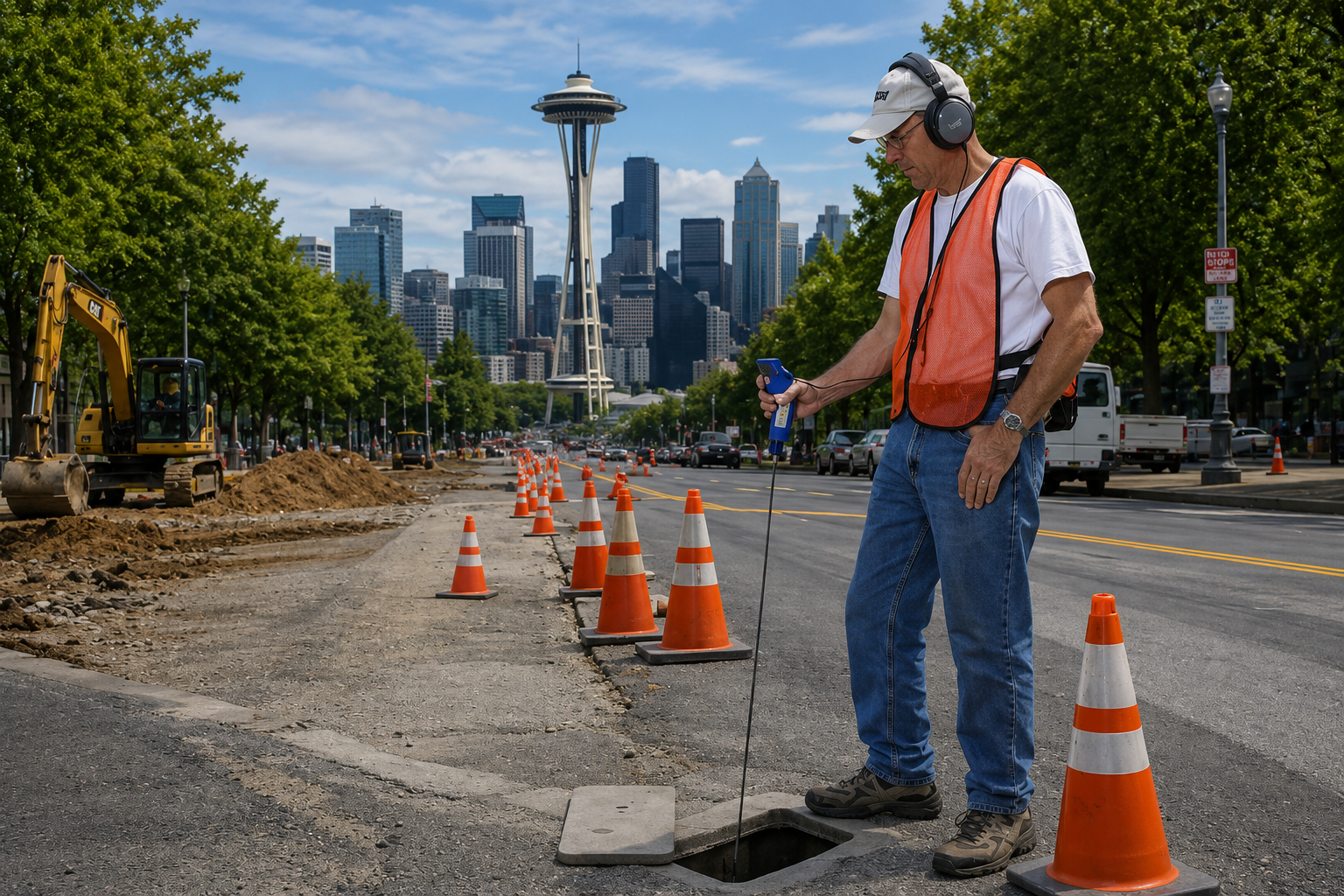
Underground plumbing problems can create multiple challenges that affect property owners, contractors, and facility managers. The process of choosing between identifying the problem source and installing new piping sections becomes essential when water loss or system performance issues show up. A leak detection specialist in Washington will provide clients with better information before they decide to start digging or perform repair work.
Before any subsurface work begins, it is also important to follow Washington State requirements, including contacting 811 in accordance with RCW 19.122 to identify public utilities. The 811 location service primarily helps with public infrastructure detection, but it does not cover the identification of private service lines. The two systems demonstrate different approaches, which lead to different procedures when it comes to discovering and fixing plumbing problems.
Businesses need to understand all cost elements for detection and replacement operations because pricing alone does not show the entire picture, which includes environmental factors, system intricacy, and available inspection technologies.
What Leak Detection Involves
Leak detection focuses on identifying the probable location of a leak within a plumbing system without unnecessary excavation. Services related to leak detection in Washington often rely on a combination of diagnostic methods to evaluate subsurface conditions.
Technicians typically assess factors such as pipe material, depth, surrounding soil conditions, and accessibility. Detection methods may include acoustic listening devices, tracer gas techniques, and electromagnetic locating when applicable. These tools are selected based on the characteristics of the site and the type of plumbing system involved.
It is important to note that results can vary depending on environmental conditions, background noise, and pipe configuration. Detection methods are designed to improve visibility into subsurface conditions, but they are subject to operational limitations.
Cost Considerations of Leak Detection
From a cost perspective, detection services are generally focused on narrowing down the area of concern rather than immediately performing physical work. In many scenarios, plumbing leak detection in Washington can help reduce unnecessary excavation by identifying areas that require closer attention.
Costs associated with detection may vary depending on:
- Site accessibility and preparation requirements
- Pipe length and system complexity
- Environmental conditions such as soil type and surface materials
- The need for multiple diagnostic methods
Because no single technology can identify every condition in all environments, technicians may combine multiple approaches to improve overall findings. This integrated approach helps provide more targeted information, which can assist contractors and property owners in planning next steps.
When Pipe Replacement Becomes Necessary
Pipe replacement is typically considered when damage is confirmed, when systems have reached the end of their service life, or when repeated issues occur within the same infrastructure. In contrast to investigative services, replacement involves physical work such as excavation, removal, and installation performed by licensed contractors.
In some cases, leak detection specialist services are used prior to replacement to determine whether a localized repair is possible instead of replacing an entire system. This can be particularly useful in complex sites where multiple utilities are present.
Replacement costs are influenced by several factors, including:
- Depth and location of the pipe
- Surface conditions (concrete, asphalt, landscaping)
- Presence of other underground utilities
- Access limitations and safety requirements
These variables can significantly increase overall project costs compared to targeted detection efforts.
Comparing Detection vs Replacement Costs
When comparing detection and replacement, it is important to recognize that each serves a different purpose. Detection focuses on identifying potential problem areas, while replacement addresses confirmed issues through construction activities.
In many cases, leak detection is used as an initial step to help determine whether full replacement is necessary or if a more localized solution may be considered. This approach can help avoid unnecessary disruption, especially in areas with congested underground infrastructure.
However, detection does not eliminate all uncertainty. Site conditions such as pipe material, depth, and environmental interference can affect the ability to isolate a leak with complete certainty. As a result, findings are typically used to guide further action rather than serve as final confirmation.
Role of Technology in Cost Efficiency
Modern subsurface investigation relies on combining multiple technologies to improve the understanding of underground conditions. Services related to plumbing leak detection in Washington may involve acoustic detection, tracer gas methods, and other locating technologies, depending on the situation.
Because each method has specific strengths and limitations, technicians evaluate site conditions before selecting the most appropriate approach. For example:
- Acoustic methods may help identify pressurized leaks, but can be affected by noise or depth
- Tracer gas techniques may assist in certain scenarios, but require controlled conditions
- Electromagnetic locating may support tracing conductive lines when accessible
By integrating these methods, technicians aim to provide more reliable information while working within the constraints of the environment.
Conclusion
Choosing between leak detection and pipe replacement depends on the condition of the system, site variables, and project goals. Detection services can provide valuable insight into subsurface conditions and may help reduce unnecessary excavation, while replacement addresses confirmed issues through construction work performed by qualified contractors.
Understanding that no detection method can guarantee complete identification is essential when evaluating costs and planning next steps. Technologies are used to improve visibility, but results depend on site conditions, accessibility, and system characteristics. By approaching plumbing issues with a clear understanding of both investigative and construction processes, property owners and contractors can make more informed decisions that support safer and more efficient project planning. For projects requiring detailed subsurface investigation, C-N-I Locates Ltd. provides utility locating and inspection services designed to support excavation planning and infrastructure awareness.