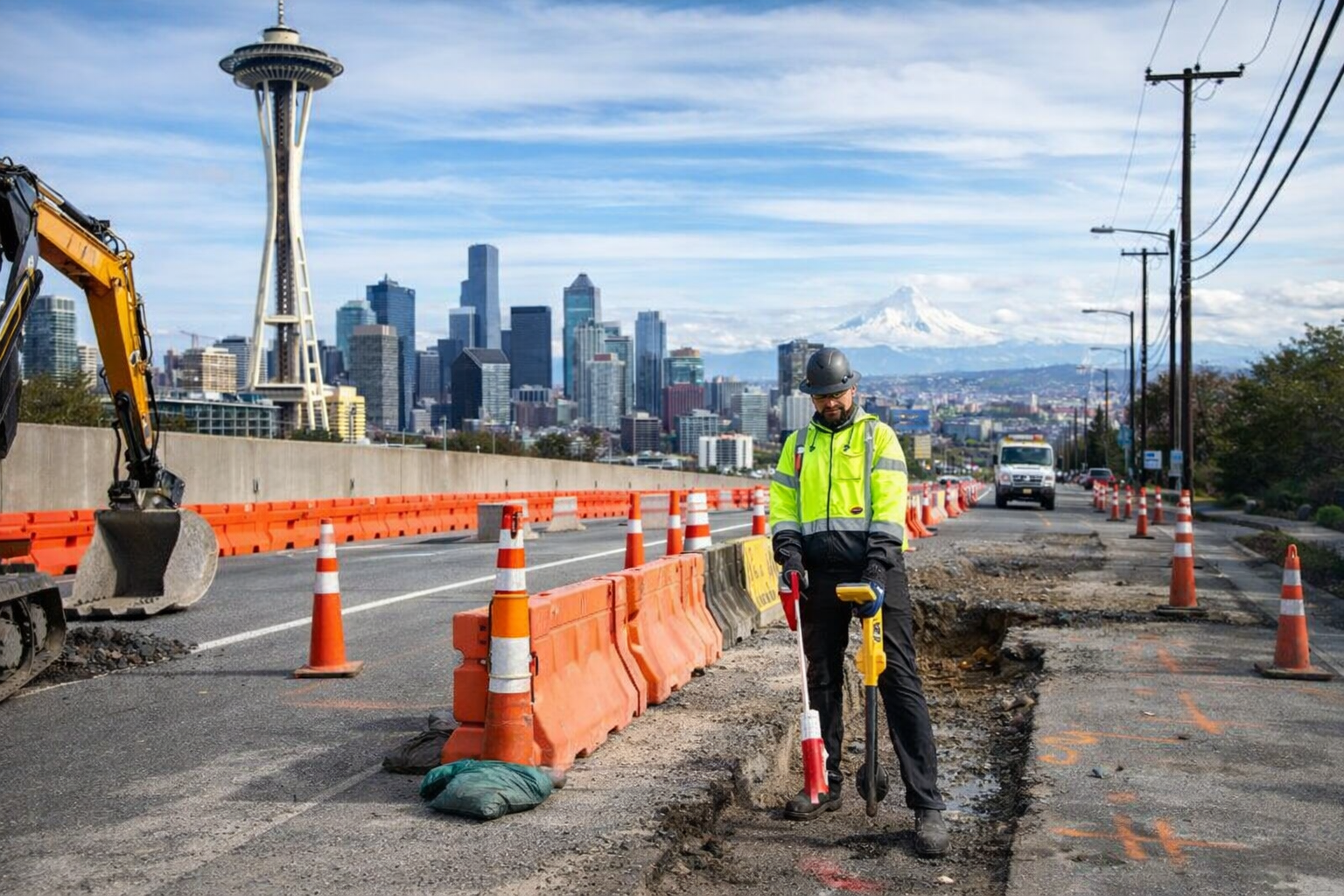
Excavation and construction jobsite safety requires workers to have full knowledge of the underground conditions that exist beneath the surface. The presence of underground electrical lines, water services, and communication conduits needs to be documented because these systems often remain hidden from view. This is where underground utility locating in Washington plays an important role in helping contractors and property owners make informed decisions before breaking ground.
Before any excavation begins, it is important to recognize that Washington State law requires contacting 811 in accordance with RCW 19.122. The procedure identifies public utilities, yet it does not encompass all privately owned utility systems. The process of creating safe operational environments requires organizations to develop a better understanding of their subsurface conditions.
What Utility Locating Covers on a Jobsite
Utility locating focuses on identifying and marking subsurface infrastructure that could be affected during excavation or construction activities. The process requires detecting conductive utilities such as electrical lines, gas pipelines, and metallic water services according to the availability of access and the specific conditions of the site.
Technicians typically begin by evaluating available records, visible access points, and site layout. From there, different detection methods may be used to trace utility paths and mark their approximate locations. These markings help crews understand where utilities are likely present, supporting safer excavation practices.
It is important to note that visibility depends on several factors, including soil composition, utility material, depth, and environmental conditions. Because of these variables, results may vary, and locating is considered an investigative process rather than a guaranteed outcome.
Understanding the Limitations of 811 Locates
While 811 plays a critical role in excavation safety, it is designed primarily to locate public utilities. This means that certain types of infrastructure may not be included in standard 811 markings.
Examples of utilities that may not be covered include:
- Private electrical lines serving buildings
- Irrigation systems and private water services
- Sewer laterals connecting structures to main lines
- Privately installed communication or data conduits
In situations where ownership is unclear, property owners and contractors may need to verify whether utilities are public or private. This is where private utility locates in Washington become relevant, as they can assist in identifying infrastructure that falls outside the scope of public locating systems.
Why Private Utility Awareness Matters
Private utilities are often installed after original site development or may not be fully documented in public records. As a result, they can present challenges during excavation if their locations are unknown.
Understanding the presence of private utilities helps:
- Reduce the likelihood of accidental damage
- Support better excavation planning
- Improve coordination with contractors and engineers
- Enhance overall jobsite safety
Because these utilities are not always included in public locating services, additional investigation may be required depending on the project scope and site conditions.
Technologies Used to Improve Subsurface Visibility
Utility locating often involves the use of multiple technologies working together to improve subsurface visibility. No single method is capable of identifying all utilities in every environment, which is why technicians evaluate site conditions and select appropriate tools accordingly.
Electromagnetic locating is commonly used to detect conductive utilities, while other methods may be introduced when conditions limit its effectiveness. For example, a GPR utility locator in Washington can assist in identifying subsurface anomalies and non-conductive utilities such as plastic pipes, depending on soil conditions and depth.
Additional technologies may include:
- Magnetic detection for ferrous objects
- Acoustic detection for plastic water lines
- Camera inspections for internal pipe tracing
- Utility mapping for recording surface markings
These methods are often used in combination to confirm findings and work around site-specific limitations. Even with multiple technologies, results depend on environmental conditions, accessibility, and utility characteristics.
The Role of Combined Methods in Jobsite Safety
Because subsurface conditions vary from site to site, combining multiple locating methods helps improve the overall understanding of underground infrastructure. Technicians may use different technologies together to cross-check findings and address limitations that one method alone cannot overcome.
This approach supports:
- More informed excavation planning
- Reduced uncertainty in congested utility areas
- Better communication between project owners
- Safer working conditions for crews on site
By integrating different detection techniques, projects can benefit from a more comprehensive view of subsurface conditions while still recognizing that limitations may exist.
Conclusion
Jobsite safety is closely tied to how well underground conditions are understood before excavation begins. While 811 helps identify public utilities, it may not provide a complete picture of all subsurface infrastructure. Recognizing the presence of private utilities, understanding service limitations, and using multiple locating technologies can help improve planning and reduce potential risks.
Utility locating is not about guaranteeing results but about improving visibility and supporting safer decision-making based on site conditions. By combining different detection methods and maintaining awareness of limitations, contractors and property owners can approach excavation with greater confidence.
For projects across Washington, C-N-I Locates Ltd. provides utility locating and subsurface investigation services designed to support safe planning and informed project execution.