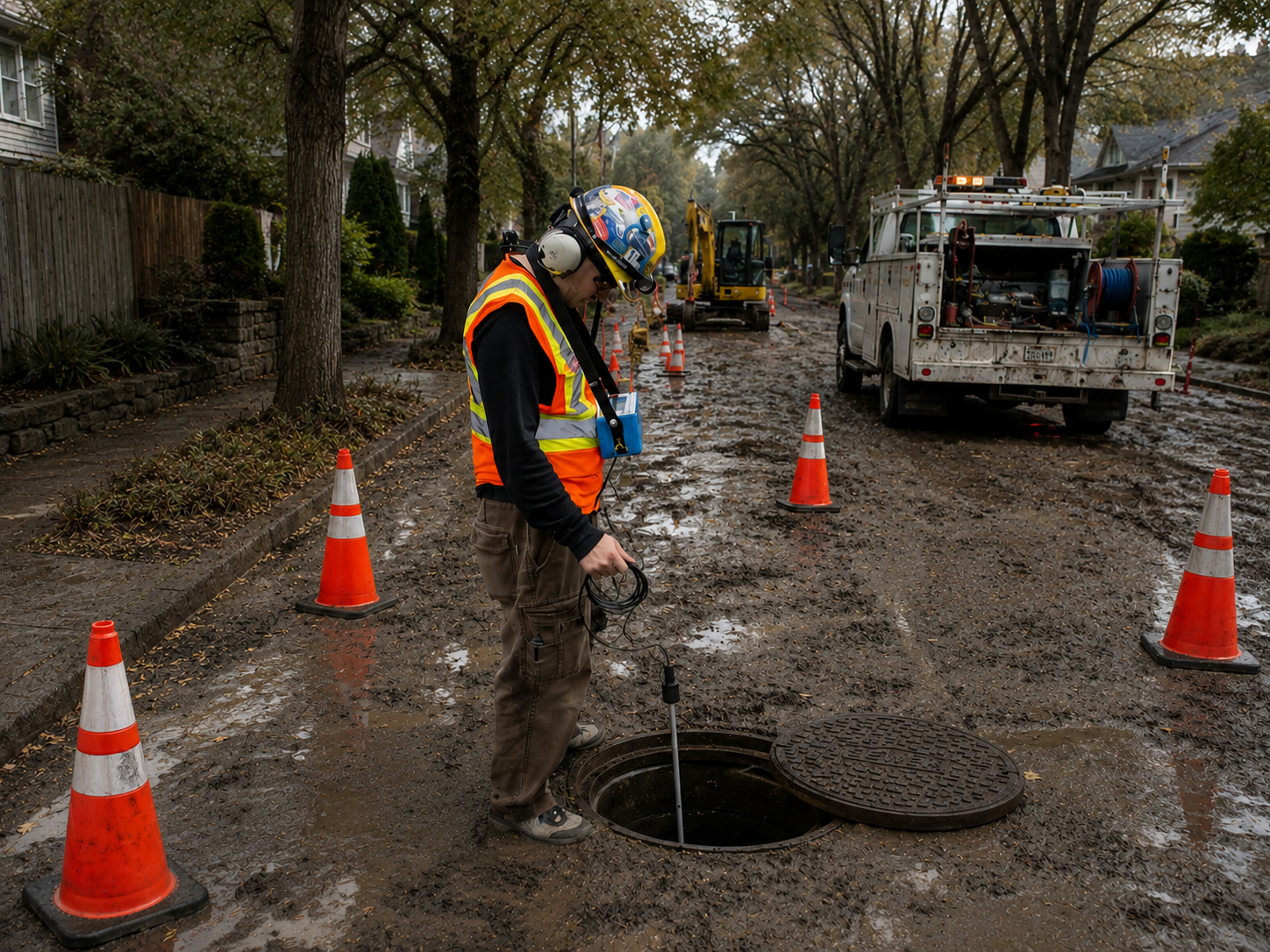
Underground leak investigations are influenced by far more than the condition of the pipe itself. Soil composition, moisture retention, surface materials, utility congestion, and environmental noise can all affect how leak signals travel through the ground. For property owners, contractors, and facility managers evaluating underground leak detection services, understanding how soil conditions influence acoustic testing and utility locating methods can help establish realistic expectations before fieldwork begins.
In many leak investigations, technicians combine multiple service applications depending on site conditions, pipe material, utility accessibility, and client approval. Acoustic leak detection, electromagnetic utility locating, Ground Penetrating Radar (GPR), non-metallic line detection methods, and video inspection technologies may all be utilized during a water leak inspection, depending on the complexity of the site.
Why Soil Conditions Matter During Leak Detection
Acoustic leak detection relies on identifying sound or vibration generated by pressurized water escaping from a pipe. That sound travels differently through various soil types and surface materials. Some conditions allow sound to transfer efficiently, while others absorb, distort, or scatter acoustic signals before they reach listening equipment.
When performing underground leak detection services, technicians evaluate several site-specific variables before beginning testing, including:
- Pipe material and pipe diameter
- Approximate pipe depth
- Soil density and composition
- Surface materials such as concrete, asphalt, gravel, or landscaping
- Background vibration and environmental noise
- Moisture saturation within the soil
- Utility congestion within the work area
- Slope of the work area
These variables can influence both signal clarity and the technician’s ability to isolate a suspected leak area.
Sandy Soil and Acoustic Signal Dissipation
Sandy soils are commonly encountered throughout portions of Washington construction and utility corridors. Sand tends to absorb and disperse vibration rather than transferring it efficiently over long distances.
During a water leak inspection, this can create several operational limitations:
- Leak sounds may weaken rapidly as the distance increases
- Acoustic signals may appear broader rather than concentrated
- Deeper utilities may produce a limited surface response
- Dry sandy conditions may reduce vibration transfer further
Technicians performing underground leak detection services may respond by reducing listening intervals, testing additional access points, or introducing supplemental locating technologies when acoustic response becomes inconsistent.
Depending on site accessibility and client approval, supplementary methods such as tracer gas leak detection may help the leak testing progress.
Clay Soil and Sound Amplification Challenges
Clay-heavy soils often retain moisture more effectively than sandy soils. In some scenarios, this can improve sound transmission during acoustic leak detection. However, saturated clay conditions may also create misleading signal reflections or broad acoustic zones that complicate interpretation.
Clay soil conditions may contribute to:
- Acoustic resonance over larger surface areas
- Signal distortion caused by excessive moisture
- Difficulty isolating the highest decibel response
- Increased interference from nearby conductive utilities
When these conditions are encountered, technicians may compare multiple listening locations while evaluating signal strength consistency across the suspected pipe route.
Because no single technology performs equally well in every environment, underground leak detection services may involve combining acoustic methods with:
- Electromagnetic locating of conductive water services
- Ground Penetrating Radar (GPR) for visible subsurface anomalies
- Traceable rods or sondes for non-metallic lines
- Magnetic detection for associated utility components, such as valves or meter boxes
- Tracer gas leak detection for leaks that are difficult to hear
The selection of supplemental technologies depends on site conditions, accessibility, and client authorization.
Rocky Soil and Surface Interference
Rocky terrain presents another common challenge during a water leak inspection. Rock layers, buried debris, and compacted aggregate can alter how acoustic vibrations move through the ground.
In these environments, technicians may encounter:
- Irregular acoustic reflections
- Multiple competing vibration paths
- Limited microphone coupling with uneven surfaces
- Increased environmental interference from surrounding infrastructure
Acoustic leak detection equipment, such as the Seba KMT HL7000 or Sewerin A200, may still assist with identifying suspected leak areas, but technicians must evaluate the reliability of the signal response carefully.
If conductive piping is accessible, electromagnetic locating equipment such as the Vivax vLoc3 or Radio Detection RD8200 may be utilized to help confirm the pipe alignment before additional leak testing occurs.
Wet Soil Conditions and Detection Limitations
Moisture saturation can significantly affect underground leak detection services. Wet ground conditions may either improve or complicate leak detection depending on the pipe type, leak severity, and surrounding infrastructure.
Potential operational limitations associated with saturated soil include:
- Sound migration beyond the actual leak area
- Elevated background moisture masks smaller leaks
- Reduced GPR visibility in conductive soils
- Standing water is interfering with surface listening procedures
- Difficulty accessing valves, meters, or exposed utilities
Ground Penetrating Radar performance is especially dependent on soil conductivity and moisture content. In highly saturated or clay-rich environments, radar penetration depth and subsurface visibility may become limited.
For this reason, technicians may discuss service limitations with the client before implementing additional technologies.
Non-Metallic Water Lines and Soil-Related Challenges
Non-metallic utilities often present additional challenges during a water leak inspection because plastic pipes do not conduct electromagnetic locating signals unless tracer wire or insertion devices are available.
When technicians cannot electromagnetically trace the pipe, they may evaluate alternative methods such as:
- Acoustic pipe detection
- Traceable push cameras
- Sondes or inserts
- Tracer gas leak detection
- Ground Penetrating Radar (GPR)
Acoustic pipe detection methods rely heavily on soil conditions because sound transmission quality directly affects pipe tracing capability.
In some environments, technicians may recommend exposing and uncoupling a section of pipe so a traceable rod or steel fish tape can be inserted into the line. Once inserted, an electromagnetic signal may be applied to assist with locating the utility route.
These recommendations are typically discussed with the client when site conditions limit standard locating procedures.
Utility Congestion and Signal Distortion
Subsurface utility congestion can further affect underground leak detection services, particularly in developed commercial or industrial environments.
Buried electrical systems, communication lines, metallic infrastructure, reinforced concrete, and nearby water services may all influence signal interpretation.
Technicians commonly perform:
- Electromagnetic utility locating
- Passive frequency sweeps
- Induction sweeps
- Ground surface inspections
- Access point verification
These procedures help identify conductive infrastructure that may interfere with leak detection activities.
In some cases, multiple utility locating methods are combined to help distinguish the suspected water service from surrounding infrastructure.
Why Leak Detection Results Vary Between Sites
Every leak investigation is influenced by unique field variables. Even when the same equipment and procedures are utilized, two properties may produce very different acoustic responses because of:
- Soil composition
- Pipe depth
- Pipe material
- Surface accessibility
- Utility congestion
- Environmental vibration
- Moisture saturation
- Previous site disturbance
- Slope of the work area
Because of these variables, leak detection findings should always be evaluated within the context of the site conditions present during testing.
Depth estimates, signal interpretation, and suspected leak areas are influenced by field conditions and may vary throughout the investigation process.
Conclusion
Soil composition plays a major role in how acoustic signals travel, how utilities respond to locating equipment, and how leak investigations are interpreted in the field. Sandy soils, saturated clay, rocky terrain, and congested utility corridors can all influence the effectiveness of underground leak detection services and the selection of supplemental technologies.
A structured water leak inspection often involves combining multiple locating methods depending on site accessibility, utility material, environmental conditions, and operational limitations. Understanding these variables helps contractors, property owners, and facility managers make informed decisions before excavation or repair planning begins.
As an underground water leak detection company in Washington, C-N-I Locates Ltd. provides utility locating and leak detection services that support contractors, property owners, and utility professionals by identifying and documenting subsurface infrastructure conditions while communicating realistic service limitations based on actual field conditions.