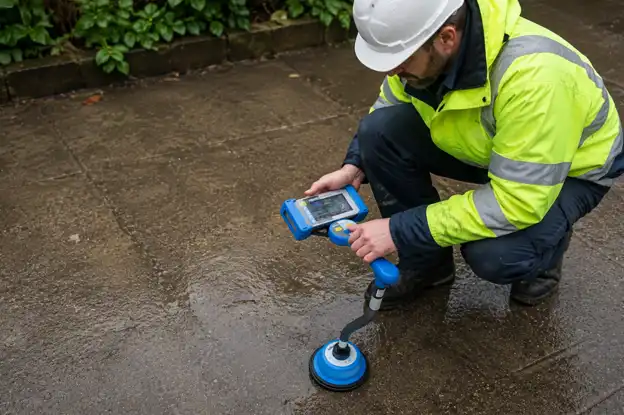
A leak can hide in a surprisingly ordinary place. Water may leave a buried pipe, travel through soil, move along a utility trench, and surface several feet away from where the leak began. By the time someone notices a wet patch, the water may have already taken a different route. That is why underground leak detection services are more than just finding moisture. Technicians start at the source and understand what the site is telling them.
And sometimes, the site does not tell the whole story.
Why Can a Real Leak Be Difficult to Hear?
A small leak may produce very little sound. Even when it does, the pipe may not carry that sound very far. Pipe material makes a difference. Plastic water lines can be harder to investigate acoustically than metallic ones. Depth, pipe size, pressure, fittings, soil conditions, and the nature of the leak can also change the sound reaching the surface.
Then add everything happening above ground. A passing truck can shake the surface. Pumps can run nearby. Machinery can create constant vibration. Wind can interfere with outdoor testing. A faint leak signal can quickly become hard to separate from the surrounding noise. That does not mean the technician has nothing to work with. They can listen at several accessible points, compare changes along routes, and assess how the response behaves. A strong sound at one point does not automatically mean the leak sits directly beneath that spot.
Water also moves. If a leak is under concrete, water may travel through the surrounding soil to the surface. The moist spot doesn’t necessarily indicate where it leaked from.
Different Methods Reveal Different Clues
No single detection method tells the whole story. Acoustic testing listens to the sound of escaping water. Tracer gas testing introduces a detectable gas into suitable pipes to find signs of escape. Thermal imaging reveals the temperature differences on accessible surfaces, while GPR can provide another way to investigate subsurface conditions.
Each method also has its boundaries. Tracer gas can spread outside in strong winds. The test requires a suitable access point. A hard-to-reach valve, backflow preventer, frost-proof hose bib, or branch can interfere with the test. Another issue is long piping, since technicians may not be able to isolate the section of piping that needs testing.
Thermal imaging gives technicians a different kind of information. Thermal imaging used during water leak investigations can reveal unusual temperature patterns on a wall, floor, ceiling, or another accessible surface. That is why experienced fieldwork rarely relies on a single reading.
What Can Change the Investigation?
For leak detection services in Washington, the property itself can create obstacles before testing even begins.
- A suspected line may run beneath concrete, asphalt, landscaping, or a building.
- A useful valve may be inaccessible.
- A long pipe may offer few practical points for testing.
- Unknown branches can also send sound or tracer gas along an unexpected route.
- Small lines may produce weaker acoustic responses.
- Deep lines can make surface listening harder.
- Non-metallic piping may require another detection approach because standard electromagnetic locating needs a conductive path.
Depending on the circumstances, technicians may use acoustic equipment, traceable devices, GPR, or other suitable methods. Even the suspected source can be misleading. Irrigation problems, for example, may involve a faulty sprinkler component or valve rather than a damaged buried line. Pool water loss can also result from evaporation, with temperature, wind, and humidity affecting the rate.
Before calling it a leak, technicians must separate these possibilities.
Conclusion
Leak detection deals with hidden water, imperfect access, changing ground conditions, different pipe materials, and competing signals. Good fieldwork recognizes those realities instead of forcing every property into the same approach. CNI Locates LTD provides utility detection and inspection services focused on identifying and documenting subsurface information while clearly communicating the conditions that may affect a leak investigation.