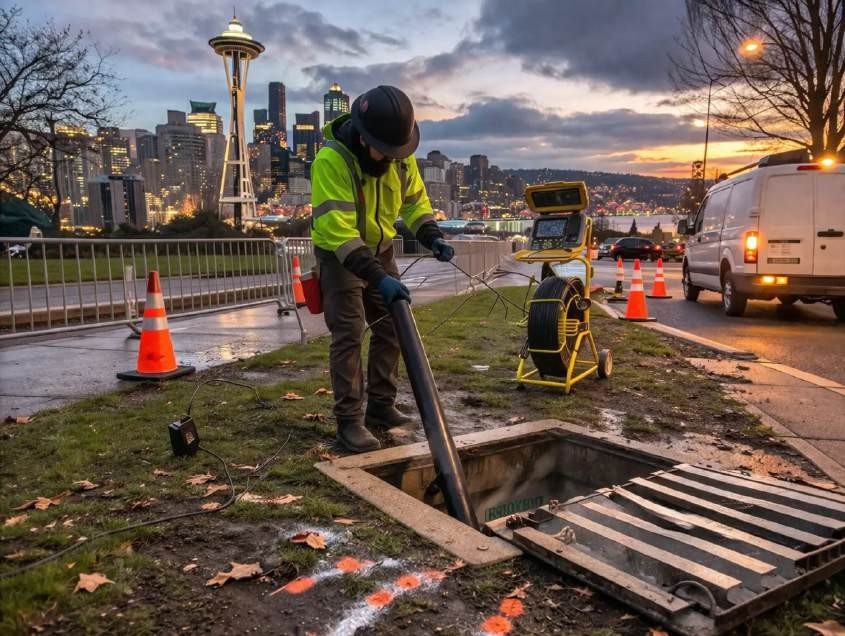
Understanding underground utilities before excavation is a critical part of safe project planning in Washington State. While many detection methods focus on tracing signals from the surface, certain underground systems require internal inspection to improve visibility. This is where video camera inspection in Washington becomes relevant, especially when dealing with pipes, conduits, or systems that are not easily detectable using traditional surface-based methods.
Before any digging begins, it is important to contact 811 in accordance with RCW 19.122 to identify public utilities. However, property owners and contractors should also be aware that private infrastructure may not be included in those locates. This is why additional inspection and locating methods are often considered when evaluating subsurface conditions.
What Is Camera Sonde Locating?
Camera sonde locating is a process that combines internal pipe inspection with surface-based locating. A small transmitting device, known as a sonde, is attached to or integrated with a camera system. As the camera moves through a pipe or conduit, the sonde emits a signal that can be detected from the surface using specialized receivers.
This method is commonly used during video pipe inspections in Washington to help identify the route of underground piping systems. It allows technicians to correlate what is seen inside the pipe with its approximate position on the surface.
Because this process involves both internal inspection and external signal detection, it provides a way to better understand subsurface infrastructure when direct access or traditional locating methods are limited.
When Camera Sonde Locating Is Used
Camera sonde locating is typically used in situations where pipes cannot be reliably traced using electromagnetic methods alone. This may include non-conductive materials such as PVC or situations where tracer wires are not present.
A sewer video inspection can assist in identifying pipe direction, changes in alignment, or areas where access points are limited. It is especially useful when locating building sewer laterals, storm lines, or drainage systems that may not be part of public utility records.
Technicians evaluate site conditions, pipe accessibility, and project requirements before determining whether this method is appropriate. In many cases, it is used alongside other locating approaches to improve overall visibility.
Limitations and Site Considerations
Like all subsurface investigation methods, camera sonde locating is subject to service limitations. Signal detection depends on factors such as pipe conditions, depth of the pipe, surrounding infrastructure, and environmental interference.
While performing video camera inspection in Washington, technicians may encounter situations where the sonde signal is weaker or less consistent due to these variables. Additionally, obstructions within the pipe, such as debris or sharp bends, may limit how far the camera system can travel.
Depth readings obtained during this process are considered approximate and may vary depending on site conditions. This reinforces the importance of interpreting results within the context of environmental and operational limitations.
How It Works with Other Technologies
Camera sonde locating is rarely used in isolation. Instead, it is often combined with other detection methods depending on the complexity of the site.
For example, during a video pipe inspection, technicians may also use electromagnetic locating to trace conductive utilities nearby or Ground Penetrating Radar (GPR) to identify additional subsurface features. These technologies can complement one another by addressing different types of utilities and site conditions.
This combination approach allows technicians to cross-reference findings and work around the limitations of individual methods. No single technology can identify every utility or subsurface condition, which is why multiple service applications are often considered when evaluating a site.
Private Infrastructure and Inspection Needs
Many underground systems inspected using camera sondes fall under private ownership. These may include building sewer lines, private storm drains, or internal conduits that are not covered by public utility locating services.
Public utility locates requested through 811 typically focus on publicly maintained infrastructure, while private systems may require additional investigation.
Understanding this difference helps property owners and project teams make informed decisions when planning excavation or maintenance work. It also reinforces the need for appropriate inspection methods when public records do not fully represent site conditions.
Conclusion
Camera sonde locating provides a practical way to connect internal pipe inspection with surface-level understanding of underground infrastructure. Combining visual inspection with signal detection helps improve awareness of pipe routes and conditions, particularly in situations where traditional locating methods may have limitations.
Because subsurface conditions can vary widely, technicians often rely on multiple technologies to support accurate interpretation and safe planning. Approaches such as camera inspection, electromagnetic locating, and other detection methods may be used together depending on site requirements and client approval.
Working with experienced professionals like C-N-I Locates Ltd. allows property owners, contractors, and engineers to better understand subsurface conditions while maintaining a focus on safety, compliance, and informed decision-making.