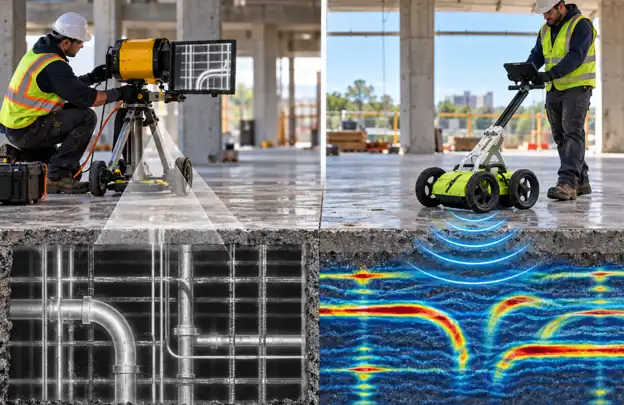
Before drilling, coring, or cutting concrete, it helps to know what is underneath. Rebar, conduits, post-tension cables, and other embedded features can sit out of sight. A Concrete Scanner helps identify what may be in the work area before the surface is disturbed.
GPR and X-ray can both provide information about embedded features within concrete, but they work very differently. While GPR uses electromagnetic signals and can scan from one side, X-ray uses radiation and needs access to both sides. That difference affects setup, access, and how the investigation fits the jobsite. So, which method makes more sense? The answer depends on the concrete, the site, and what needs to be investigated.
Benefits of Concrete Scanning Using Ground Penetrating Radar
GPR works by sending electromagnetic pulses into concrete and analyzing the signals that return. That makes the scanning process relatively mobile and adaptable to different concrete surfaces. Here are reasons that make GPR practical on a jobsite:
- One-sided operation: The technician scans from the accessible face of concrete. There is no need to go to the opposite side to place a detector.
- No radiation controls: GPR doesn’t involve ionizing radiation, so the exposure controls required for X-ray work are not needed.
- Large-area scanning: The equipment can move across a selected section instead of being limited to individual exposure points.
- Field-based findings: Technicians can review and interpret collected data during the scanning process.
- Portability: Modern GPR systems are built to be portable and move along floors, slabs, walls, and other concrete surfaces.
- Multiple embedded features: Depending on site conditions, GPR can be used to detect rebar, conduits, post-tension cables, voids, and other subsurface modifications.
For concrete slab scanning, one-sided scanning can be quite effective and make a difference. The underside of the slab can be obstructed by another floor, a ceiling, machinery, or a populated space. GPR does not need such space to conduct the scan.
The technique still relies on the concrete. Moisture, composition, age, and reinforcement density of concrete may affect the signal behavior and the interpretation of the collected information.
Benefits of Concrete Imaging Using X-Ray
X-ray is more of an image-focused approach. A radiation source is positioned on one side of concrete while a detector sits on the opposite side. The exposure produces a radiograph of the area between them.
A concrete X-ray can be useful when the site can accommodate that arrangement and a radiographic image is suitable for the investigation. Its key advantages include:
- Clear visual imaging: A radiograph can provide a readily viewable image of dense features within the examined area.
- Strong image-based information: Instead of interpreting reflected radar signals, the technician works from a developed radiographic image.
- Useful for focused examinations: X-ray can be limited to a defined imaging area, allowing the required equipment to be positioned correctly.
- A different view of embedded features: Where site conditions allow, X-ray offers another way to examine what lies within concrete.
The trade-off is the setup. The source and detector must be positioned on opposite sides, and the area around the radiation source requires appropriate controls. The image also needs to be processed before it is available for review.
Why Choose GPR Over X-Ray for Concrete Imaging?
The choice becomes easier when the technologies are viewed through the lens of worksite realities.
- Access: GPR works from one side. X-ray needs two. When the opposite face of a slab or wall is inaccessible, GPR has a clear logistical advantage.
- Site activity: X-ray requires controls around the radiation exposure. GPR does not. That difference can matter in occupied buildings, active facilities, and construction areas where shutting down surrounding activity is difficult.
- Speed of the workflow: A Ground Penetrating Radar (GPR) Scanner can move across the selected surface while the technician reviews the information collected in the field. X-ray requires an exposure and subsequent processing before the radiograph can be interpreted.
- Area being examined: GPR can be moved across a broader section of concrete, while X-ray is generally tied to specific exposure setups.
- Information handling: GPR keeps the scanning and initial interpretation closely connected. X-ray creates a separate radiographic image that must be processed before review.
But this does not mean that X-ray becomes irrelevant. Its imaging technique may become useful where access to both sides of the structure is available, and the operating conditions are applicable to the location. It is just that GPR provides a more flexible procedure for many concrete imaging cases.
Conclusion
Technology becomes just a part of the process. The collected data should also be analyzed, taking into account the limitations of the technique.
CNI Locates LTD provides concrete imaging and private utility locating services. We locate and mark subsurface utilities without installing, repairing, excavating or certifying utilities.