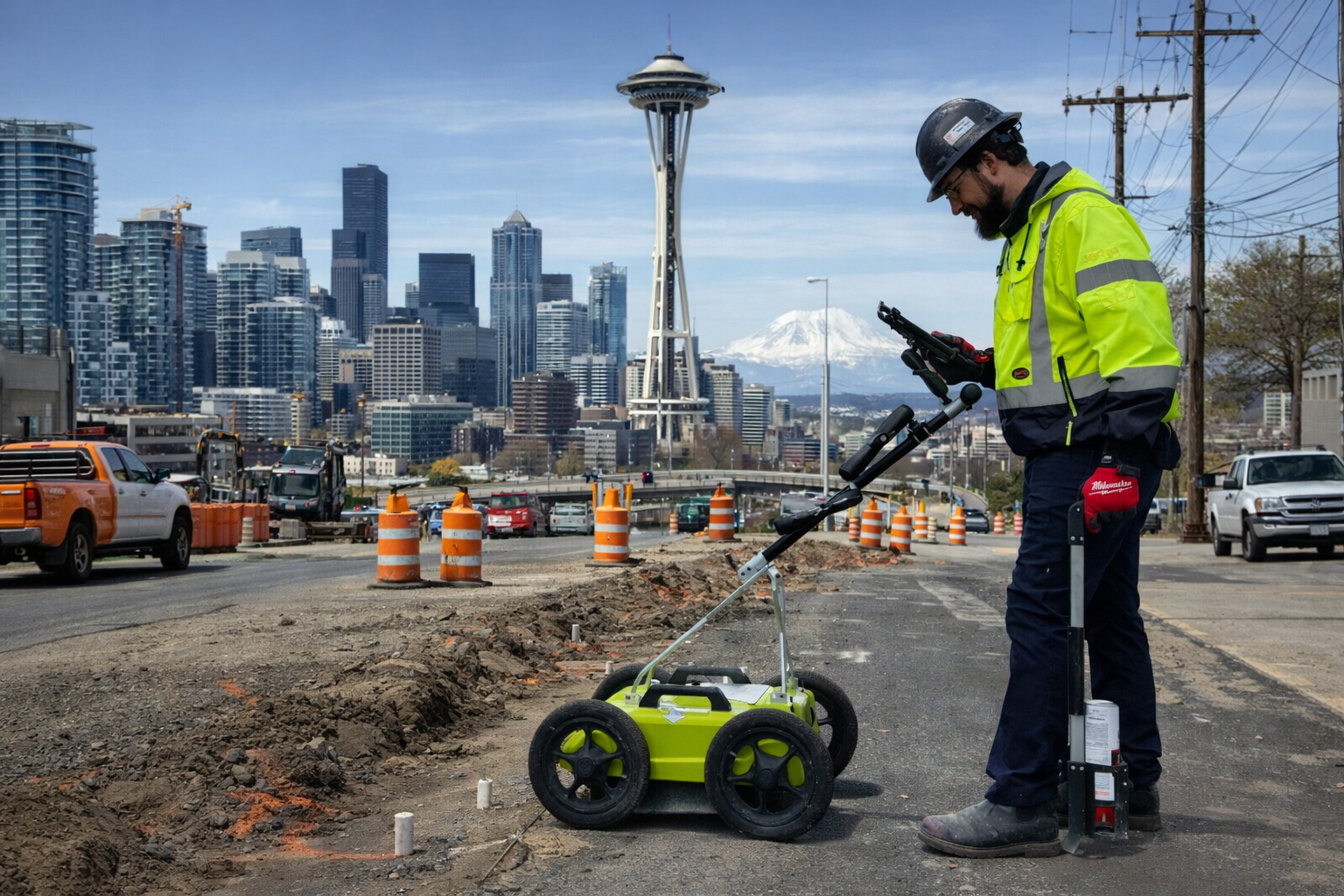
Excavation and subsurface work in Washington require careful planning, coordination, and a clear understanding of underground infrastructure. The most frequent reason for utility damage occurs when workers fail to identify what exists underground before they start their excavation. Services such as underground utility locating in Washington help to identify the location of buried utilities, yet they function as only one element of a larger safety procedure. Washington State law, including RCW 19.122, requires contacting 811 before excavation to help identify public utilities. Safety violations continue to happen because workers do not understand the project scope, utility locating operational limits, and the actual conditions of the site. Understanding these violations helps reduce risk and supports safer project planning.
Failure to Contact 811 Before Excavation
One of the most frequent safety violations is beginning excavation without contacting 811. This step is required to help identify publicly owned utilities such as power, gas, and communication lines. Skipping this process increases the likelihood of striking critical infrastructure.
However, it is also important to understand that 811 locates typically focus on public utilities and may not include privately owned infrastructure. Property owners and contractors should verify whether utilities are public or private when planning work. Even when 811 has been contacted, additional investigation may be required depending on site conditions and project scope.
Misunderstanding the Scope of Utility Locating
Another common issue is assuming that all underground utilities have been identified after a standard locate. This misunderstanding can lead to unsafe excavation practices. While services such as underground utility mapping in Washington can document located utilities, mapping only reflects what has been identified during the locating process.
Subsurface conditions can vary significantly based on soil composition, installation methods, and accessibility. Nonconductive utilities, abandoned lines, or undocumented infrastructure may not always be detectable using a single method. For this reason, technicians often evaluate site conditions and determine whether additional technologies are needed to improve visibility.
Ignoring Service Limitations and Site Conditions
A significant safety concern arises when project teams overlook the operational limitations of detection technologies. All locating methods, including electromagnetic locating and Ground Penetrating Radar, are influenced by environmental and site-specific factors.
For example:
- Soil conditions may affect signal transmission
- Utility material impacts detectability
- Congested utility corridors can create signal interference
- Limited access points may restrict tracing capabilities
Because of these variables, results depend on field conditions at the time of service. A locating company may identify many utilities within a work area, but complete visibility cannot always be assumed. Recognizing these service limitations is essential for safe excavation planning.
Relying on a Single Detection Method
Relying on one detection method is another frequent violation that can lead to incomplete utility identification. No single technology can locate every type of underground infrastructure in all environments.
Technicians often combine multiple methods depending on site conditions and client approval. These may include:
- Electromagnetic locating for conductive utilities
- Ground Penetrating Radar for subsurface imaging
- Acoustic detection for water lines
- Camera inspections for internal pipe tracing
- Magnetic detection for ferrous components
These technologies are used as complementary tools to help confirm findings and work around site limitations. Combining methods can improve overall understanding of subsurface conditions, though results may still vary depending on environmental factors.
Inadequate Communication and Site Verification
Poor communication between project managers is another contributing factor to safety violations. Failing to review findings, markings, and limitations with all parties involved can result in incorrect assumptions during excavation.
Technicians typically review located utilities, markings, and any areas of uncertainty with the client after completing the work. This step helps ensure that expectations are clearly understood. When necessary, additional services or verification methods may be recommended to address unresolved concerns.
Overreliance on Depth Estimates
Depth information is often misunderstood during excavation planning. While depth estimates may be provided under certain conditions, they are based on signal response and field interpretation.
Actual depth can vary due to factors such as:
- Soil composition
- Installation practices
- Surface disturbances
- Utility type
- Signal Interference
- Ability to perform a true depth calibration
Because of these variables, depth should be treated as an approximation rather than a fixed measurement. Relying on assumed exact depths can increase the risk of utility damages during excavation.
Conclusion
Safety violations related to underground utilities often stem from misunderstandings about scope, limitations, and proper procedures. Even when initial steps such as contacting 811 are completed, additional precautions are often necessary to address private utilities, complex site conditions, and detection limitations. Services like underground utility locating and underground utility mapping can support safer planning by improving subsurface visibility. By combining multiple technologies, acknowledging service limitations, and maintaining clear communication, project teams can reduce risks and make more informed decisions before excavation begins. For professional support and detailed subsurface investigation services, C-N-I Locates Ltd. provides data-driven insights to assist contractors, engineers, and property owners in Washington.