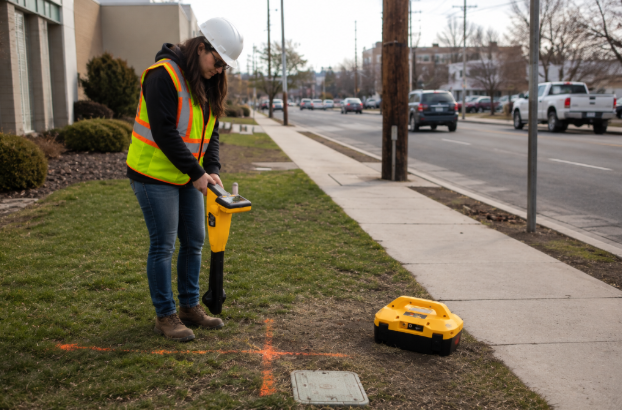
EM locating is more complicated than simply placing a receiver above the ground and following the signal. This involves understanding how signals behave, how utilities respond to signals, and how field conditions affect data collection. Like other inspection methods, underground utility locating requires expert interpretation to be effective.
When a user overlooks the necessary steps of the detection process, many challenges arise. Identifying such errors helps project team members appreciate the need for professionals to detect utilities based on locating data.
Mistake 1: Starting Without Reviewing the Site Conditions
Before applying signals, professionals need to review the work area, available entry points, and utility features. Available features, such as utility meters, vaults, handholes, pedestals, transformers, and conduits, can help technicians locate appropriate points for signal application. Available records may also provide additional information on the utility routes.
If you ignore this step, locating will become more difficult, as you might miss opportunities to apply signals and other important factors that influence your work.
Mistake 2: Choosing the Wrong Signal Application Method
EM location is highly dependent on how the signal reaches the utility at the site of interest. A common error is applying the technique without considering the site environment.
Experts offering Private Utility Locating Service in Washington may use different approaches, including:
- Direct connection if access is allowed
- Inductive clamping around the accessible conductor
- Induction in case there is no access to the conductor
Each method has its considerations. Direct connection would provide the most accurate information. Induction has to be evaluated carefully, since there is a chance that other conductors will also receive the signal. Choosing the right method requires knowledge of the utility’s environment.
Mistake 3: Ignoring Passive Sweeps After Active Locating
Another common myth is placing too much focus on active signal location without accounting for passive locating. The process of passive sweeps makes it possible for technicians to detect natural electromagnetic signals originating from:
- Electrical lines with current
- Communication signals
- Cathodic protection
This provides more information about the area being tested and can help in identifying signals that need further investigation.
Mistake 4: Using Only One Frequency During Locating
Different utilities and site conditions will respond differently depending on the frequency chosen during the locating process. Using a single frequency regardless of the type of utility might make locating more difficult.
Low frequencies can travel farther through conductive utilities, while high frequencies can aid in specific location circumstances. This decision will depend on the properties of the utilities, their availability, and the project’s needs.
Frequency selection is a component of the locating process and requires expert judgment based on field conditions.
Mistake 5: Ignoring Signal Distortion and Utility Cluttered Areas
In urban and developed areas, many underground facilities have been installed over time. Such factors could lead to interference or could make the assessment of individual utilities hard.
The following factors might affect the utility locating process:
- Presence of conductive material nearby
- Proximity of utilities to each other
- Signal bleed-off
- Soil condition
- Depth of utility
- Limited points of access
Such considerations are taken into account by professionals when tracing the utility facilities.
Using Proper EM Locating Practices for Better Site Understanding
EM locating helps provide critical data on conductive underground utilities; however, the success of the process relies on the proper use of processes and equipment. Additional services, such as GPR, can also help on projects that require more information about site conditions. Different detection techniques are useful for different types of information; professionals will choose their techniques based on site conditions.
CNI Locates LTD provides services such as utility locating, ground-penetrating radar, structural scanning, and inspections to help contractors, engineers, and property owners understand existing site conditions.