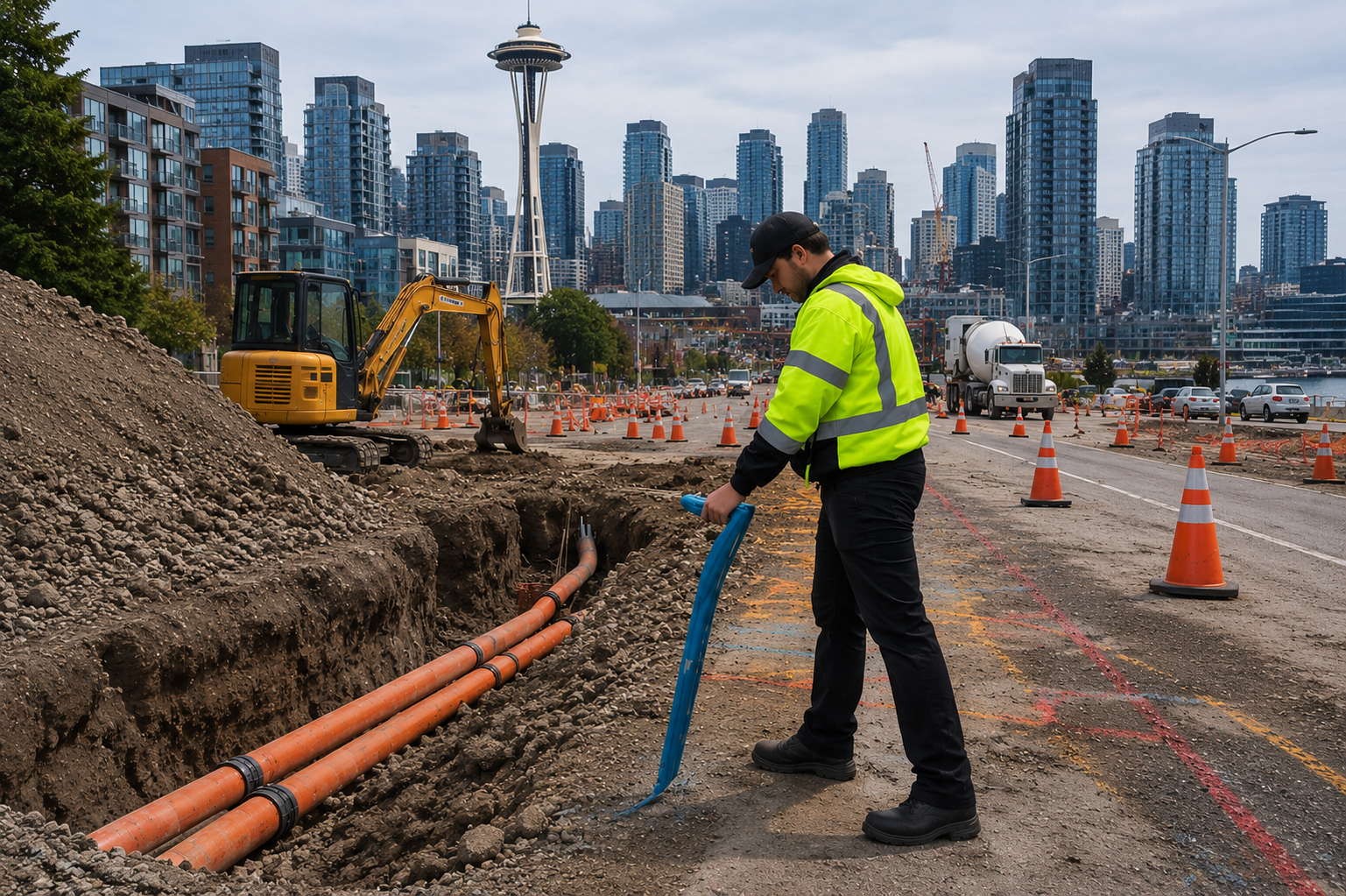
Construction and excavation sites face a critical problem as underground utility strikes create dangerous situations, which result in safety risks, interrupted services, and expensive project delays. In Washington, where infrastructure varies across urban and suburban environments, understanding what contributes to these incidents is essential. While many projects involve a utility locator service in Washington, damage can still occur when underlying risks are not fully understood. The excavation process requires operators to create detailed plans before beginning their work, including contacting 811 in accordance with RCW 19.122, which governs underground utilities damage prevention. Even proper procedures do not guarantee complete visibility, as subsurface conditions, missing information, and restricted areas on the site create obstacles. The identification of underground utilities enables contractors, engineers, and property owners to select better choices, which results in safer excavation operations.
Incomplete Utility Information Before Excavation
One of the most common causes of underground utility strikes is relying on incomplete or outdated information. While public utility locates requested through 811 provide critical insight into publicly owned infrastructure, they may not include privately installed utilities such as irrigation systems, private electrical feeds, or building service lines. This gap can create a false sense of visibility if not addressed properly.
Projects involving underground utility locating in Washington often require a deeper understanding of both public and private infrastructure. Technicians typically review available records, site plans, and visible access points, but these sources may not always reflect current conditions. Changes over time, undocumented installations, or missing records can all contribute to uncertainty beneath the surface.
Limitations of Detection Technologies
Another key factor in utility strikes is misunderstanding the capabilities of detection technologies. Methods such as electromagnetic locating and Ground Penetrating Radar (GPR) are widely used, but each has operational limitations. Soil composition, utility material, burial depth, and environmental interference can all influence detection results.
When locating underground utilities, technicians evaluate site-specific conditions before selecting appropriate tools. Electromagnetic locating is typically effective for conductive utilities, while GPR may assist in identifying non-conductive or unknown subsurface features. However, neither method can provide complete visibility in every scenario. Results depend on site conditions, and certain utilities may remain undetectable due to material type or access constraints.
Failure to Recognize Private Utility Risks
Utility strikes frequently occur when private utilities are not identified prior to excavation. While 811 plays an important role in identifying public utilities, it does not typically include privately owned infrastructure. This distinction is critical for projects involving residential, commercial, or industrial properties.
Engaging a utility locator service can help address these gaps by focusing on private utility locating. Technicians may assess site conditions, review available documentation, and apply multiple detection methods to improve visibility. Even so, private utility detection is subject to limitations, and findings must be interpreted within the context of site-specific variables.
Overreliance on a Single Detection Method
Relying on a single locating method can significantly increase the risk of utility strikes. No single technology is capable of identifying all subsurface utilities under every condition. Effective locating often involves combining multiple service applications to improve overall accuracy.
For projects involving underground utility locating, technicians may use a combination of electromagnetic locating, GPR, magnetic detection, or camera-based inspections, depending on the site. These technologies complement one another and help overcome individual limitations. Even with combined methods, technicians must evaluate environmental conditions, access constraints, and signal interference that may affect results.
Challenging Site Conditions and Environmental Factors
Site conditions play a major role in the likelihood of utility strikes. Congested utility corridors, variable soil composition, surface materials such as concrete or asphalt, and limited access to utility connection points can all reduce detection effectiveness.
During the process of locating underground utilities in Washington, technicians often encounter situations where environmental factors limit visibility. For example, highly conductive soils may distort electromagnetic signals, while dense reinforcement within concrete can interfere with GPR readings. Additionally, buried utilities without tracer wires or accessible connection points may be difficult to detect using standard methods.
Conclusion
Multiple elements work together to create underground utility strikes, which do not stem from any single factor. Multiple factors, including insufficient data, restricted technological capabilities, environmental obstacles, and misunderstanding about utility detection boundaries, lead to these incidents. Project teams achieve greater excavation awareness when they identify these elements, enabling them to plan their work more effectively.
The first step in Washington requires any excavation work to follow RCW 19.122 and contact 811 before starting the digging process. The understanding of public and private utility operations, together with detection system operational boundaries, stands as a vital knowledge base. The process of locating
multiple sites through different methods and site condition assessment will enhance visibility, although environmental factors and data availability will determine the final outcomes.
C-N-I Locates Ltd. offers subsurface data that enables contractors, engineers, and property owners to achieve better safety in their planning and decision processes. The service helps to identify potential utility conflicts, which reduces the probability of encountering unplanned obstacles while digging for excavation work.