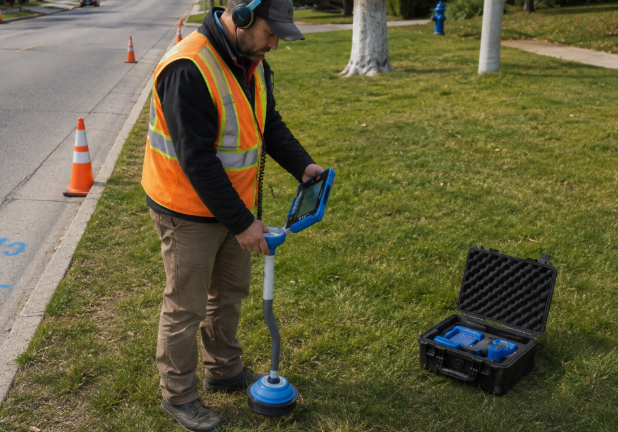
Hidden leakages rarely follow any consistent pattern. A leaking service line could run under the concrete floor slab, yard paving, landscaping, warehouses, mechanical yards, or utility corridors without ever giving an obvious indication on the ground surface. In most cases, the water leaks far from the source of the problem, making a visual inspection ineffective. This is why underground leak detection services combine multiple technologies to assess the condition of pipes before moving to repairs.
Why Modern Leak Detection Uses More Than One Technology?
In leak investigations, many factors differ from one location to another. The type of pipe, the depth at which it is buried, pressure, the soil type around it, and accessibility are factors that determine how technicians proceed with investigating a leak. The response varies depending on the type of material of the pipe, the surface, and the subsurface.
As no technique is as effective under all field conditions, technicians often use acoustic leak detection in combination with GPR.
Acoustic Detection Focuses on Sound Transmission
The process of acoustic water leak inspection depends on the sound produced when water under pressure leaks from any hole, separation, or fitting failure. Special devices help the technician compare the sound decibel levels and frequencies in the suspect pipeline.
Many field factors affect the acoustics, such as:
- Type of pipe
- Thickness of the pipe walls
- Water pressure in the pipeline
- Pipe diameter
- Burying depth
- Soil density
- Surface type
A leak from the pipeline beneath the lawn usually sounds differently than one beneath a busy street, factory building, or parking lot. All these factors can influence the results of the investigation. That is why the technician should interpret the acoustic results based on the site conditions rather than only on sound levels.
GPR Provides Additional Context Below the Surface
A professionally conducted water leak survey can include GPR if technicians need more data on the condition of the subsurface layer around the possible leak location.
Unlike acoustic equipment, GPR is not used to evaluate sound decibel levels or detect active water flow. GPR technology sends electromagnetic pulses into the soil and evaluates the reflections produced by differences in material composition, density, and structure.
In accordance with the site conditions, GPR can help to determine:
- Possibilities of routing pipes
- Underground construction elements
- Voids or other subsurface conditions
- Differences in surrounding material properties
- Utility congestion at the survey site
- Subsurface conditions below slabs or paved surfaces
The data obtained helps technicians understand the conditions around the possible leak site.
The Value of Combining Both Detection Methods
The biggest benefit of combining acoustic and GPR is the nature of the data provided by each technology. Acoustic devices estimate the potential presence of water by measuring sound transmission. GPR estimates the subsurface condition and buried objects that could influence the interpretation of the results obtained by the acoustic device.
Imagine an industrial plant where technicians are trying to find a suspected water leak under a reinforced loading dock. The acoustic devices can detect stronger sounds in a certain section of the slab. The GPR will estimate subsurface conditions and determine whether any buried utilities, reinforcements, conduits, or other underground objects are present in the same area.
This way, using both technologies allows comparison of two separate sources of information.
Supporting Investigation Activities Without Performing Repairs
Slab leak detection services help contractors, facility managers, property owners, plumbers, and maintenance departments obtain information about the current situation. The detection process does not include any excavation, pipe replacing, utility repairs, or changes.
By integrating acoustic detection techniques with Ground Penetrating Radar, technicians can examine suspected leak conditions from two independent perspectives: sound transfer and sub-surface imagery. With advanced detection technologies and techniques, CNI Locates LTD provides information that helps clients and industry experts during leak assessments.