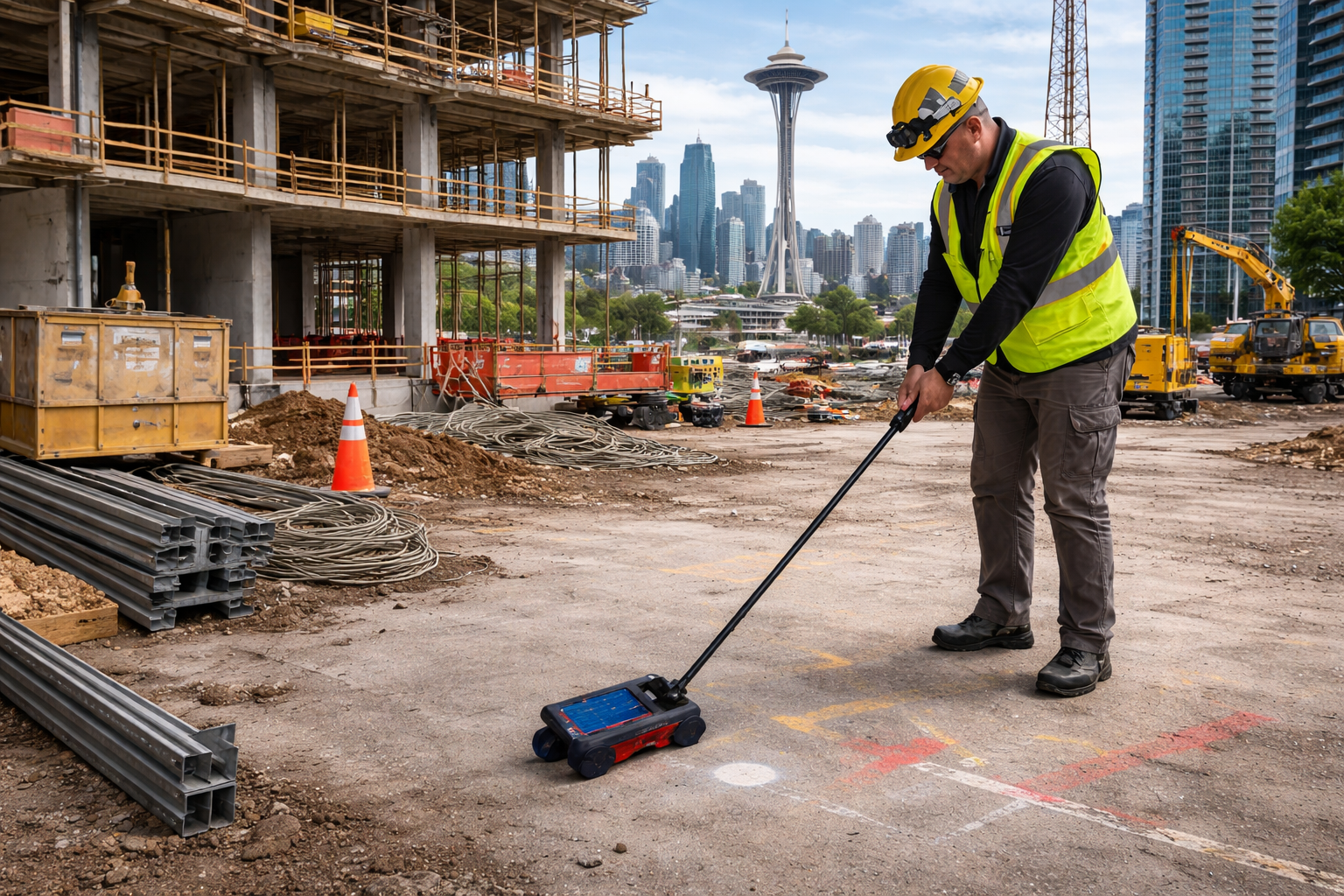
Modern construction uses post-tension slabs because they deliver both structural strength and design flexibility, but their installation creates difficulties for subsurface work. Safety and planning work demand knowledge of underground conditions before any drilling, coring, or slab cutting begins. The detection of underground objects uses technologies such as Ground Penetrating Radar (GPR) for this purpose. Projects that involve concrete scanning in Washington use GPR technology to detect hidden structural features within concrete slabs. The technology requires users to comprehend its operational capabilities and its limitations, particularly when they deal with post-tension systems where cables are under tension and require careful handling.
What GPR Can Detect in Post-Tension Slabs
Ground Penetrating Radar (GPR) detects subsurface features in concrete through its non-destructive scanning method, which relies on signal reflections. GPR scanning on post-tension slabs enables the identification of the following elements:
- Post-tension cables
- Reinforcing steel (rebar)
- Conduits and embedded utilities
- Voids or anomalies within the slab
GPR technology functions as an essential tool for visualizing embedded elements in concrete slabs before any physical work commences. The radar signal reflects differently depending on the material it encounters, allowing trained technicians to interpret patterns and identify objects within the slab.
However, interpretation depends heavily on technician experience and site conditions. GPR does not produce a simple “image” like an X-ray, but rather data that must be analyzed carefully.
Limitations of GPR in Post-Tension Applications
While GPR is a valuable tool, it does not “see through” concrete in a perfect or absolute sense. Several factors can affect performance, including:
- Concrete thickness
- Density of reinforcement
- Moisture content
- Presence of multiple overlapping objects
- Surface accessibility and preparation
Technicians conducting GPR concrete scanning need to consider these factors. The presence of signal interference in heavily reinforced or congested slabs makes it more difficult to interpret results. The scanning process produces depth estimates that serve only as rough approximations, as actual results depend on material characteristics and signal performance.
Because of these factors, results should be understood as informed interpretations rather than definitive confirmations of all embedded conditions.
Why Post-Tension Slabs Require Careful Investigation
Post-tension slabs contain high-tension steel cables that are critical to structural performance. Damaging these cables during drilling or cutting can create safety risks and structural concerns. For this reason, subsurface investigation is typically performed prior to any modification work.
In many cases, concrete scanning is used to help identify safe drilling or cutting zones. However, technicians also communicate that detection is influenced by site-specific conditions. Clear communication between the technician and client helps ensure that expectations align with the capabilities of the technology.
It is also common for technicians to recommend maintaining safe clearance distances from detected features, especially in post-tension systems where tolerance zones are critical.
Combining Technologies for Better Visibility
No single technology can identify all subsurface conditions in every scenario. For this reason, technicians may combine multiple methods depending on site conditions and project requirements.
In projects involving concrete slab scanning in Washington, GPR may be used alongside other approaches such as:
- Electromagnetic locating for conductive utilities
- Visual inspection of structural drawings or as-built records
- Supplemental verification methods when accessible
These combined approaches can help improve overall visibility and support more informed decision-making. Each method contributes different information, and together they provide a more complete understanding of the structure.
Similarly, during GPR concrete scanning, technicians evaluate whether additional methods may be beneficial based on what is observed during the scan.
Conclusion
GPR is a valuable tool for scanning post-tension slabs, but it does not provide absolute visibility or certainty. Its effectiveness depends on factors such as slab composition, reinforcement density, and site conditions. Understanding these limitations is essential when planning any work involving concrete structures. By combining technologies and applying careful interpretation, subsurface conditions can be better understood before proceeding with drilling or cutting. For projects requiring professional subsurface investigation and structural scanning support, C-N-I Locates Ltd. provides services designed to assist with safe planning and informed decision-making.